Ramadan does not just change what your audience eats and when they sleep — it rewires when the entire Gulf goes online. Post at your usual times and you are talking to an empty room; move with the month's rhythm and you reach the most engaged feeds of the year.
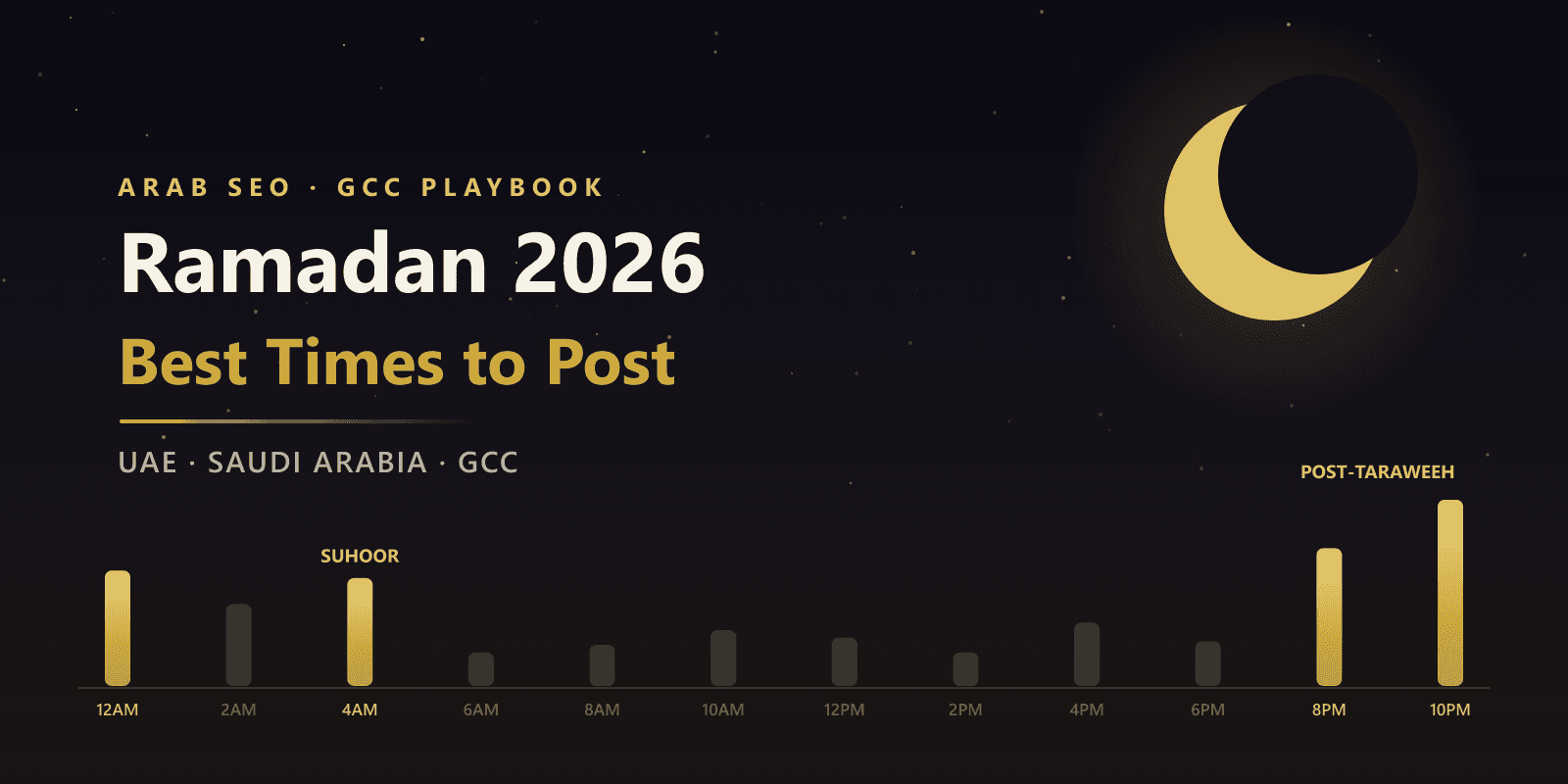
Quick answer: during Ramadan, the best times to post on social media in the UAE, Saudi Arabia and the wider GCC are 8:00–11:30 PM after iftar, peaking in the post-taraweeh window of roughly 10:00 PM–1:00 AM, plus 3:00–5:00 AM around suhoor and the 4:30–6:00 PM pre-iftar countdown. The quietest hour of the day is iftar itself.
This guide comes from the Arab SEO team, distilled from what we watched across Gulf client accounts and platform data through Ramadan 2026 (18 February – 19 March 2026). It is built to be reusable: every window below is anchored to suhoor, iftar and taraweeh rather than to fixed clock times, so the playbook holds just as well for Ramadan 2027 — the expected dates are at the end.
The short answer: four windows win Ramadan
All times are local. The UAE runs on UTC+4 and Saudi Arabia on UTC+3, and prayer times drift a few minutes across the month — so treat these as bands, not alarms.
| Window | UAE (Dubai) | Saudi Arabia (Riyadh) | Best for |
|---|---|---|---|
| Pre-iftar countdown | 4:30 – 6:15 PM | 4:00 – 5:50 PM | Recipes, countdowns, tonight's offers |
| Post-iftar family window | 7:30 – 9:30 PM | 7:00 – 9:00 PM | Feel-good content, polls, UGC, second-screen |
| ★ Post-taraweeh prime time | 9:30 PM – 1:30 AM | 9:00 PM – 1:00 AM | Launches, drops, offers, livestreams — the peak |
| Suhoor window | 3:00 – 5:15 AM | 2:30 – 4:45 AM | Long-form video, delivery offers, low-competition reach |
Why Ramadan flips the social media clock
Ramadan 2026 began on Wednesday 18 February after the crescent was sighted, and ran 29 days to Eid al-Fitr on 20 March. The structural changes it brings are what move the engagement curve, and they repeat every year:
- The working day shrinks. The UAE's Ministry of Human Resources and Emiratisation cut private-sector hours by two per day for the month — six-hour days for every employee, Muslim or not. Saudi Arabia's labour law makes the same reduction for fasting employees. Commutes, lunches and after-work scrolling all move.
- The day is bracketed by two meals at extreme hours. On day one in Dubai, fajr — the end of suhoor — fell at 5:34 AM and iftar at 6:18 PM on Dubai's published Ramadan timetable; by the final week iftar landed around 6:25 PM and fajr near 5:05 AM. Everything social — meals, prayer, family, shopping — compresses into the night between them.
- The baseline is already enormous. DataReportal's Digital 2026 UAE report counts around 11 million active social identities — roughly 99% of the population — spending just under three hours a day on social platforms. In Saudi Arabia, the same report series has Snapchat alone reaching about 25 million users — near 9 in 10 adults. Ramadan pushes those numbers higher still, and pushes them later.
- The audience tells us where it is. MENA consumer research keeps ranking the same three moments as the most active: after iftar, after taraweeh, and before suhoor — with clear surges at 4–6 AM and 8 PM–midnight.
Ramadan 2026 added one more twist: it was the Gulf's first properly winter Ramadan in decades. Snap's Ramadan 2026 insights flagged shorter fasting hours, more outdoor evening socialising, and overlaps with Saudi Founding Day and Riyadh Season — which stretched the late-night window even further. Expect the same shape, slightly earlier each year, through 2027 and 2028.
The four golden windows, hour by hour
1) The pre-iftar countdown — 4:30–6:15 PM UAE, 4:00–5:50 PM KSA
Work ends early, roads fill, and a fasting audience starts planning tonight's table. This is the strongest slot of the daylight hours, and it belongs to food, countdowns and anticipation. Recipe views climb all afternoon — people watch iftar dishes while fasting, not after eating.
Example: a supermarket or F&B brand posting a 45-second "on the table in 20 minutes" iftar recipe Reel at 5:00 PM, or a retailer running a "3 hours left" Story countdown sticker for a same-night offer. Keep the tone appetising but respectful — anticipation, not indulgence-shaming. And never schedule a promotion to land in the exact minutes of the maghrib adhan.
2) The post-iftar family window — 7:30–9:30 PM UAE, 7:00–9:00 PM KSA
Phones come back out twenty to forty minutes after the fast breaks. Energy is high, families are together, and Ramadan's famous television dramas (the musalsalat) put a second screen in every hand — social chatter about the night's episodes spikes here, especially on X and Snapchat. This window rewards warmth over hard selling: greetings, community stories, polls, quizzes and user-generated content travel furthest while people are relaxed and sharing.
Example: a Dubai café reposting guests' iftar photos to Stories at 8:45 PM with a "book tomorrow's table" link — borrowed authenticity, posted exactly when tomorrow's iftar is being discussed.
3) Post-taraweeh prime time — 9:30 PM–1:30 AM UAE, 9:00 PM–1:00 AM KSA
This is the one to circle. Isha fell at 7:32 PM in Dubai on day one, taraweeh prayers follow it, and by 9:30–10:00 PM the Gulf's real Ramadan evening begins: malls trade past midnight, majlis and Ramadan tents fill, and feeds hit their deepest, longest sessions of the entire year. Across the accounts we manage, it is consistently the window where launches, offer reveals and livestreams earn their best organic reach — and regional survey data ranks it right beside the after-iftar slot at the top.
Example: a Saudi electronics retailer revealing its "deal of the night" at 10:30 PM on Snapchat and TikTok, or a fashion label dropping one Eid capsule piece nightly at the same post-taraweeh minute so the audience learns the ritual and comes back for it.
4) The suhoor window — 3:00–5:15 AM UAE, 2:30–4:45 AM KSA
The strangest and most underrated window in social media. A meaningful share of the region is awake for the pre-dawn meal — MENA surveys put early-morning activity around a quarter of users, and delivery platforms see a genuine suhoor order surge. Sessions here are long and unhurried: this is when long-form video, episodic content and binge formats over-perform. It is also the cheapest reach of the day for paid campaigns, because most advertisers are asleep.
Example: a cloud kitchen pushing a suhoor bundle with a delivery deep-link between 2:30 and 3:30 AM, or a content brand premiering its nightly mini-episode at 3:00 AM sharp through the last ten nights, when even more of the audience is awake for worship.
The dead zones: when posting is wasted
- The iftar hour itself (6:15–7:30 PM UAE, 5:50–7:00 PM KSA). Families are at the table and at prayer. It is the engagement floor of the day — schedule around it, not into it.
- Mid-afternoon (1:30–4:00 PM). The fasting slump. Energy, attention and scrolling all dip after Dhuhr; save your budget and your best creative.
- Friday midday. Jumu'ah prayers empty the feeds from roughly 11:30 AM to 1:30 PM. In Saudi Arabia, remember Friday is the weekend's first day.
- The adhan minutes. Scheduling tools fire to the minute. Check the day's prayer times and keep promotional posts clear of them — it costs nothing and reads as respect.
Best times to post by platform in the UAE and Saudi Arabia
Platform mix matters as much as timing in the Gulf: TikTok reaches about 12.5 million adults in the UAE, while Snapchat is the Kingdom's default camera and messaging habit. Here is how the windows map platform by platform.
| Platform | UAE best times | KSA best times | What works in Ramadan |
|---|---|---|---|
| 8:00 PM – 12:00 AM | 7:30 PM – 11:30 PM | Reels, countdown stickers, Eid gift guides in the last ten nights | |
| TikTok | 9:30 PM – 1:30 AM, plus 3–5 AM | 9:00 PM – 1:00 AM, plus 2:30–4:30 AM | Nightly series and rituals; long late sessions reward episodic content |
| Snapchat | 8:00 PM – 12:00 AM | Post-taraweeh through 1:00 AM | AR lenses, Stories, family moments — the Kingdom's reach champion |
| X (Twitter) | 5:00–6:00 PM and 8:00–11:00 PM | 4:30–5:45 PM and 8:00–11:00 PM | Iftar-minute greetings, live drama commentary, real-time offers |
| 10:00 AM – 1:00 PM, Tue–Thu | 10:00 AM – 12:30 PM, Sun–Wed | B2B insight during the six-hour workday; expect slower weeks overall | |
| YouTube | 9:00 PM – 2:00 AM | 8:30 PM – 1:30 AM | Long-form and mini-series; suhoor-hour binge viewing is real |
| 8:00 – 11:00 PM | 7:30 – 10:30 PM | Community groups, events, offers for family decision-makers |
Two data points worth pinning to the wall. TikTok's own MENA Ramadan research measured video views up 17% and video engagement up 91% during the month — the late-night session gets longer and more interactive. And Snap reports Saudi users viewing over 10 billion Stories a day during a recent Ramadan, with consumer spending in the Kingdom up 35% through Ramadan 2025 and 89% of Snapchatters saying a compelling ad makes them likely to purchase. If TikTok is where your Gulf audience discovers, our TikTok advertising team in Dubai builds Ramadan flights around exactly these windows.
One more Gulf-specific rule: post in the audience's language, not just at the audience's hour. Arabic-first creative consistently outperforms translated afterthoughts in Saudi feeds, while Dubai usually wants both languages — the same principle behind our Arabic SEO work. A perfectly timed post in the wrong language is still the wrong post.
UAE vs Saudi Arabia vs the rest of the GCC
The anchors — suhoor, iftar, taraweeh — are identical across the Gulf, but four differences change the calendar around them:
- Clocks and prayer times. Saudi Arabia (UTC+3) runs an hour behind the UAE, and Riyadh's iftar fell roughly 20–25 minutes earlier than Dubai's through Ramadan 2026. Schedule per market; one "9 PM GCC post" does not exist.
- Weekends. UAE: Saturday–Sunday. Saudi Arabia, Qatar, Kuwait, Bahrain, Oman: Friday–Saturday. Weekend nights push the late-night peak even deeper — plan your biggest drops for Thursday night in Saudi, Friday night in the UAE.
- National moments inside the month. Ramadan 2026 contained Saudi Founding Day (22 February — day five of fasting), with Riyadh Season events still running; smart Saudi brands ran dual-moment creative that week. In Qatar, Kuwait and Bahrain, the mid-month children's nights (Garangao and Gergaoon, around the 13th–15th) are a genuine family-content spike.
- Audience mix. Dubai's population is majority non-Muslim expatriate, so daytime engagement softens but never vanishes; daytime dining and non-fasting audiences keep lunchtime commerce alive. Riyadh and Jeddah invert far more completely. Calibrate how hard you lean into the night accordingly.
Week by week: how engagement moves inside the month
Days 1–10: the reset
Routines are settling and everyone is adjusting to new sleep. Greetings, Ramadan-kareem brand moments, recipes and "surviving the first week" content perform; hold your biggest commercial pushes. Set up your posting rhythm now so the audience learns it.
Days 11–20: the groove
Habits lock in and the post-taraweeh window reaches full depth. This is the strongest stretch for sustained campaigns, nightly rituals and mid-funnel content — and when Garangao lights up family feeds in Qatar and Bahrain.
The last ten nights: worship up, shopping up
Two currents run at once. Worship intensifies — especially the odd nights around Laylat al-Qadr, when promotional volume should drop and values-led, giving-focused content should rise. Simultaneously, Eid preparation shopping surges: fashion, beauty, gifting and jewellery searches climb night after night (jewellery and gifting brands see their strongest fortnight of the season here). Run gift guides post-taraweeh and keep the tone generous rather than loud.
Eid al-Fitr: the pivot
Eid morning belongs to greetings — post between roughly 8:30 and 11:00 AM after Eid prayer, when families exchange wishes. Then the rhythm snaps back within two or three days: normal posting times resume, and the winners are brands that pre-built their post-Ramadan calendar instead of going quiet for a week.
Three worked examples from the Gulf
A Dubai restaurant's Ramadan posting day
| Time | Post | Why this minute |
|---|---|---|
| 4:45 PM | Instagram Reel — 40-second walkthrough of tonight's iftar set menu | Tables for tonight are being decided now |
| 6:10 PM | Scheduled greeting — "Iftar mubarak from our kitchen", no CTA | Lands as phones return after maghrib; goodwill, not selling |
| 8:45 PM | Stories — guest UGC reposts plus a "book tomorrow's iftar" link | Post-iftar family scroll; tomorrow is being planned |
| 10:30 PM | Reel — dessert and late-night menu, book-for-tomorrow offer | Post-taraweeh prime time; the night crowd is deciding where to go |
| 2:45 AM | Story — suhoor delivery bundle with order deep-link | Suhoor orders window; almost zero competing brand noise |
Pair the calendar with operational basics: Ramadan opening hours updated on the Google Business Profile, iftar and suhoor menus uploaded as products, and review replies kept bilingual — the checklist our local SEO team runs for every retail client. Restaurants get the compounding version of this in our restaurant marketing programme.
A Riyadh fashion e-commerce brand
Snapchat and TikTok first. One AR lens for the season, a nightly "Eid edit" drop at 10:15 PM Riyadh time so the ritual builds, a Founding Day capsule in week one, and gifting bundles pushed hard through the last ten nights. Retargeting flights run into the suhoor hours, where CPMs are quietest, and the product feed work follows the same discipline as our e-commerce SEO engagements: season-specific landing pages built weeks before the demand curve, not during it.
A B2B consultancy on LinkedIn
B2B does not move to 11 PM. Decision-makers check LinkedIn inside the six-hour workday, so the consultancy publishes Tuesday to Thursday at 10:30 AM UAE, shifts Saudi-facing posts to Sunday–Wednesday, and accepts that pipeline conversations slow — using the month to publish the evergreen, citable insight pieces that fill the post-Eid calendar. (For startups doing this on a runway, our AI-first startup SEO sprints are built around exactly that compounding pattern.)
How to check these windows against your own data
- Pull last Ramadan's hourly numbers first. Instagram Insights, TikTok Analytics and Snapchat's audience tabs all show when your followers were active by hour. Your niche may lean earlier or later than the market.
- Run a 3×3 test in week one. Three windows (pre-iftar, post-taraweeh, suhoor) × three formats (Reel/video, Story, static). By day ten you have your own benchmark instead of anyone's chart — including ours.
- Schedule per country, not per region. Duplicate the calendar for UTC+4 and UTC+3, and re-check prayer times weekly as they drift.
- Judge windows on saves, shares, DMs and site sessions — tag links with UTMs — rather than likes. Late-night Ramadan traffic converts; vanity metrics hide which window actually sells.
- Sync paid with organic. CPMs inflate in the evening peak as every brand piles in; suhoor and early-afternoon flights often buy the same audience for less. That arbitrage is half of how our PPC team plans Ramadan budgets.
Planning ahead: Ramadan 2027 dates
Astronomical calculations put the first fast of Ramadan 2027 on or around Monday 8 February 2027, with Eid al-Fitr expected around 10 March 2027 — always subject to official moon sighting. The month shifts about eleven days earlier each year, so 2027's fasting days are shorter again and the evenings even longer. Practical timeline: creative and influencer bookings locked by mid-January, always-on content loaded before 1 February, and paid budgets committed before the first week's auction inflation. Anchor everything to suhoor, iftar and taraweeh, and this article's windows will still be the right ones.
Frequently asked questions
What is the best time to post on social media during Ramadan in the UAE?
Between 8:00 PM and 11:30 PM works for most brands, and the single strongest window opens after taraweeh prayers — roughly 10:00 PM to 1:00 AM. A secondary window runs around suhoor, about 3:00 to 5:00 AM, and the 90 minutes before iftar suit food and countdown content.
What is the best time to post during Ramadan in Saudi Arabia?
The same anchors apply, but Saudi Arabia is UTC+3 and prayer times fall earlier on the clock: after-iftar engagement builds from about 7:00 PM, and the post-taraweeh peak runs from roughly 9:00–9:30 PM to 1:00 AM. The suhoor window is about 2:30 to 4:45 AM. Snapchat and TikTok carry outsized reach in the Kingdom.
Should brands post at iftar time itself?
No. The 60–90 minutes spanning maghrib — when families break the fast and pray — is the quietest stretch of the day. Schedule a warm greeting to land 15–30 minutes before iftar, then hold promotional posts until after about 7:30 PM in the UAE or 7:00 PM in Saudi Arabia.
Do Ramadan posting times apply to LinkedIn and B2B content?
Mostly not. B2B attention follows the compressed working day, so 10:00 AM to 1:00 PM is the reliable LinkedIn window, Tuesday to Thursday. Remember the weekends differ: Saturday–Sunday in the UAE, Friday–Saturday in Saudi Arabia.
When is Ramadan 2027, and when should planning start?
Astronomical calculations put the first fast on or around Monday 8 February 2027, with Eid al-Fitr expected around 10 March 2027 — both subject to moon sighting. Lock creative, budgets and influencer bookings by mid-January 2027; ad costs climb once the month begins.
Why is engagement so late at night during Ramadan?
The day inverts. Work ends early, iftar and prayer fill the early evening, taraweeh ends around 9:00–10:00 PM, and socialising, shopping and screen time then run past midnight — malls and majlis gatherings stay open into the small hours. Platforms consistently report double-digit rises in video views and engagement across MENA during the month.
Posting time is one lever; being the brand that Google and ChatGPT actually recommend during Ramadan is the bigger one. That is the discipline behind our answer engine optimization service in Dubai. If you want your Ramadan calendar — organic, paid and search — built by a team that has run it across the UAE and Saudi Arabia, talk to Arab SEO and we will map your windows to your audience data before the next crescent is sighted.