The question gets asked in Dubai boardrooms every week now, usually in the same form: our Google Ads costs keep climbing, everyone says ChatGPT is where buyers go next, so should we move the budget? It is a fair question built on a false premise — that these are two versions of the same thing. They are not. One is an auction you rent by the click; the other is a recommendation you earn and cannot currently buy. Comparing them on ROI is worth doing, but only once you understand that they succeed and fail for completely different reasons.
Quick answer: Google Ads wins on speed, predictability and attribution — you can be generating UAE leads this afternoon at a known cost per click. AI-answer visibility wins on twelve-month unit economics and defensibility, typically crossing below paid cost per lead somewhere between month four and month nine, then continuing to fall. For most UAE businesses the correct allocation is not either/or but roughly 70/30 paid-to-earned in year one, moving toward 50/50 as the earned asset compounds.
This piece is from the Arab SEO team. We run both channels for clients in this market, so we have no interest in declaring a winner — only in showing the mechanics, the maths and the measurement traps clearly enough that you can make the call on your own numbers.
What you are actually comparing
Google Ads is a rented auction position. You bid, you win an impression, you pay for the click, and the moment the card declines the traffic stops that same hour. It is the most predictable demand tap ever built, and it is pure operating expense.
ChatGPT visibility is an earned citation. When someone asks ChatGPT for the best corporate lawyer in Dubai for a free-zone setup, the model composes an answer and names sources. You cannot bid for that slot today. You get there by being the page the model finds most useful — which makes it a capital asset that keeps paying, and one a competitor cannot outbid you for overnight.
That single structural difference drives everything below: the cost curves, the attribution headaches, and the reason the honest answer is a portfolio rather than a winner.
How Google Ads actually decides who shows
Most UAE advertisers are still optimising a number Google says is not in the auction. Worth being precise, because it changes what you work on.
Your position is set by Ad Rank, computed fresh at every single search. Its inputs are your bid, auction-time measures of ad and landing-page quality, the Ad Rank thresholds, the competitiveness of that auction, the context of the search (device, location, time, the nature of the query), and the expected impact of your assets and ad formats.
The visible 1–10 Quality Score is built from three components — expected clickthrough rate, ad relevance, and landing page experience — each graded against other advertisers who showed for that exact search over the previous 90 days. But Google states plainly in its Quality Score documentation that the score itself is not an input in the ad auction; it is a diagnostic tool. The auction uses real-time quality signals instead. Practically: chasing the number is theatre, but fixing what the number measures — relevance, expected CTR, landing page experience — genuinely lowers your cost per click, because a higher-quality advertiser can win the same position at a lower bid.
The UAE context makes this expensive to get wrong. This is one of the highest-cost click markets on earth. Benchmark data published by regional agencies puts legal services roughly in the AED 18–65 per click band, real estate around AED 15–55, and healthcare near AED 10–35, with the most competitive commercial terms running well above those ranges. Those are prices for a click, not a lead. The reason is structural rather than seasonal: DataReportal's Digital 2026 UAE report puts internet adoption at effectively the entire population, and a small, affluent, almost fully-connected market means every advertiser is bidding for the same finite pool of high-value searches. At a 5% landing page conversion rate, an AED 40 click is an AED 800 enquiry before anyone has spoken to a salesperson.
How ChatGPT actually decides who it names
Here the mechanics are less familiar and far more controllable than most people assume. OpenAI documents three distinct crawlers, and confusing them is the most expensive mistake in this channel:
- OAI-SearchBot — surfaces websites in ChatGPT's search features. This is the one that decides whether you can appear in answers at all.
- GPTBot — collects content that may be used to train the foundation models.
- ChatGPT-User — fetches a page when a user or a custom GPT actively asks for it.
OpenAI's crawler documentation is explicit that sites disallowing OAI-SearchBot will not appear in ChatGPT search results. Plenty of UAE businesses added a blanket "block the AI bots" rule to robots.txt in a defensive panic and quietly deleted themselves from the channel they are now asking how to enter. Blocking GPTBot to keep your content out of training while allowing OAI-SearchBot is a coherent position. Blocking both is opting out.
One more signal worth noting: OpenAI also documents OAI-AdsBot, whose job is validating the safety of pages submitted as ChatGPT ads. Paid placement inside ChatGPT is being built. The earned position you establish now is a window, not a permanent state of the world.
What actually earns the citation is unglamorous: content that answers the buying question directly in extractable prose, specifications and prices as text rather than baked into images, unambiguous entity signals through consistent naming and schema, genuine freshness, and third-party corroboration — because models weight sources that other sources agree with. This is the work our answer engine optimization and generative engine optimization engagements do, and the requirements are concrete, which is the good news.
Head to head
| Google Ads | ChatGPT / AI answers | |
|---|---|---|
| How you appear | Win a real-time auction (Ad Rank) | Be retrieved and cited on merit |
| Cost model | Per click, every click, forever | Fixed content and technical investment |
| Time to first lead | Hours | 6–16 weeks |
| If you stop paying | Traffic ends the same day | Decays slowly over months |
| Targeting control | Precise: geo, device, hour, audience | Almost none — the model decides |
| Attribution | Click-level, near-complete | Partial; much arrives as direct |
| ★ Competitive moat | None — outbid tomorrow | Real — cannot be bought overnight |
| Best at | Capturing demand that already exists | Being chosen during research |
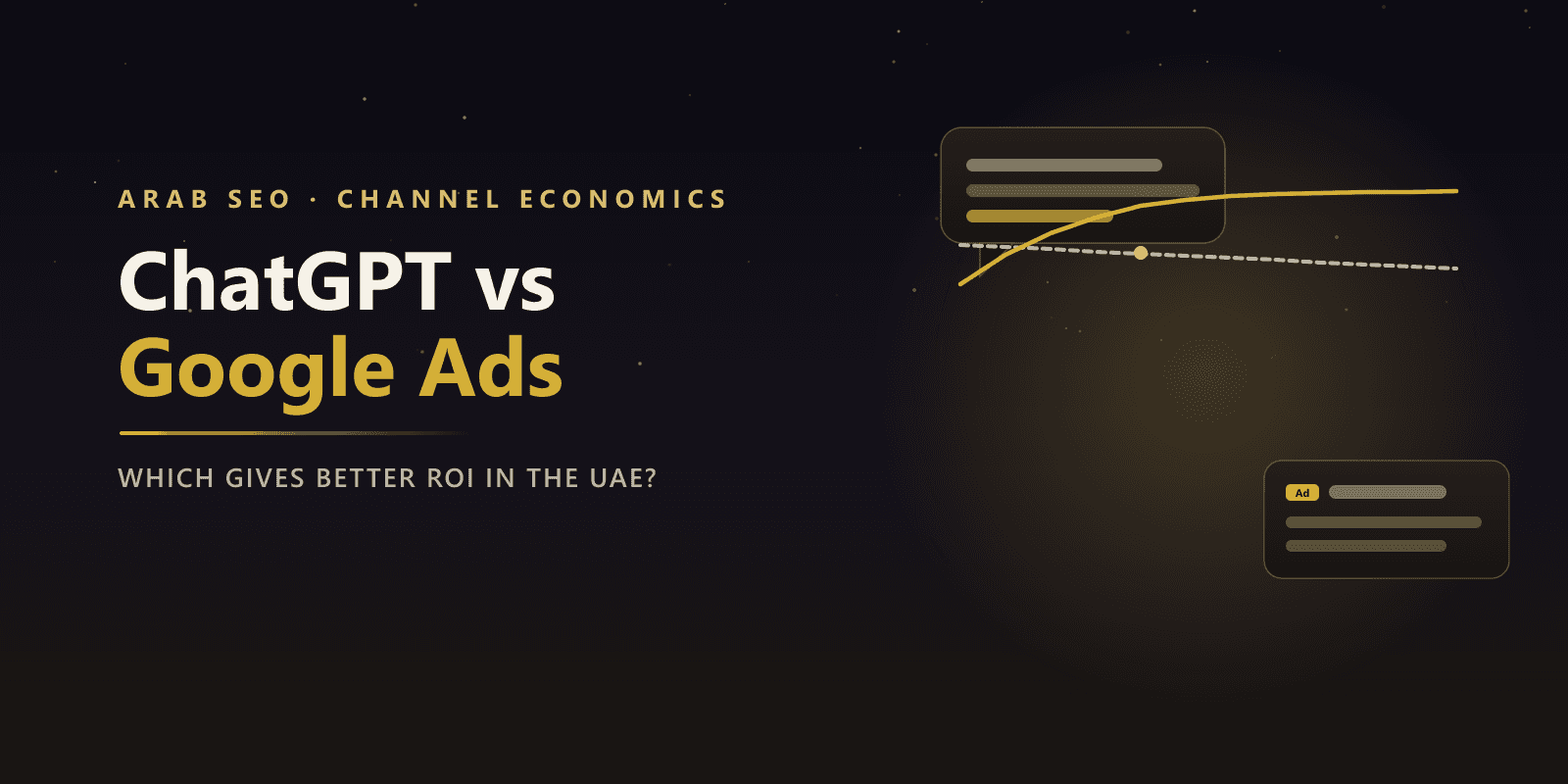
The cost curves, and where they cross
The paid line is flat by construction: you re-buy every click at market price, and in the UAE that price rises with competition rather than falling with your tenure. The earned line starts terrible — in month one you have paid for content and technical work and received almost nothing — then falls steeply as pages index, earn citations, and keep working without further spend.
Two honest caveats. First, the earned line only bends if the work is good; a blog nobody cites stays flat and expensive forever. Second, the paid line is not a failure — it is doing something the earned line cannot, which is producing revenue in month one while the other asset is still a cost centre.
Worked example: a Dubai law firm, AED 30,000 a month
Assume a corporate law firm in DIFC, average matter value AED 45,000, closing one in five qualified enquiries. Illustrative figures, but built on the UAE cost bands above.
| Line | All-in Google Ads | Split 70/30 | Split 40/60 (month 12) |
|---|---|---|---|
| Monthly budget | AED 30,000 ads | AED 21,000 ads + 9,000 earned | AED 12,000 ads + 18,000 earned |
| Clicks at AED 45 | 667 | 467 | 267 |
| Paid enquiries at 5% | 33 | 23 | 13 |
| Earned enquiries | 0 | 4 (month 3) → 18 (month 12) | 40+ |
| Total enquiries | 33 | 27 → 41 | 53 |
| Blended cost per enquiry | AED 909 | AED 1,111 → 732 | AED 566 |
| ★ Matters won at 20% | 6.6 | 5.4 → 8.2 | 10.6 |
Read the middle column honestly: diverting 30% of the budget makes month three worse. Fewer clicks, fewer enquiries, a higher blended cost per enquiry — and that dip is exactly where most UAE businesses abandon the strategy and conclude AI visibility does not work. The payoff only appears from roughly month six, and by month twelve the same AED 30,000 is producing about 60% more enquiries at nearly 40% lower cost each. If your firm cannot absorb a soft quarter, fund the earned work with additional budget rather than by cannibalising the channel currently paying the bills.
The measurement problem nobody warns you about
Google Ads gives you click-level truth. AI answers give you fog, and pretending otherwise leads to bad decisions in both directions.
Some ChatGPT traffic does appear in GA4 as a referral from chatgpt.com. A great deal does not: a user reads an answer, notes the brand name, and arrives later by typing your name into a browser — which lands in your analytics as direct or branded organic, credited to nothing. Measure this channel by click attribution alone and you will conclude it does not work, right up until you cancel it and watch enquiries fall.
What we actually use, and recommend:
- A prompt panel. Ten to twenty real buying questions for your category, run monthly through ChatGPT, Gemini and Google's AI Overviews, recording whether you are named and in what position. It is the closest thing this channel has to a rank tracker.
- Branded search volume. The most reliable proxy for AI-driven awareness — if AI answers are working, more people search your name, and Search Console shows it.
- A self-reported attribution field. One "how did you hear about us?" line on the enquiry form catches what analytics structurally cannot.
- Server log checks. Confirm OAI-SearchBot is actually reaching your key pages. If it is not crawling them, nothing else in this section matters.
- Correct paid measurement too. Enhanced conversions and offline conversion imports matter more in high-ticket UAE verticals than any bid tweak — if Google only sees form fills and never learns which ones became clients, you are optimising toward the wrong people.
Where each genuinely wins
The scorecard is deliberately balanced because the reality is. If you need enquiries this month, if your offer is seasonal or event-driven, if you are testing a new service and need signal fast, or if you must justify spend to a board in clean click-level numbers — Google Ads is the right instrument and nothing else comes close.
If your buyers research for weeks before contacting anyone, if your category is being commoditised to the point where clicks cost more than they return, if you want an asset that survives a budget freeze, or if you sell something people ask questions about before they shop for it — the earned channel is where the compounding is.
The technical work, side by side
| Layer | Google Ads | AI answers |
|---|---|---|
| Access | Account, billing, conversion tag live | Allow OAI-SearchBot in robots.txt; verify in logs |
| Relevance | Tight ad groups; copy matching query intent | One page per buying question, answered in the first 40 words |
| Landing quality | Landing page experience — speed, match, clarity | Specs and prices as text, never only in images |
| Structured data | Assets and ad extensions | Organization, Product/Service, FAQ, Breadcrumb schema |
| Measurement | Enhanced conversions, offline import, GA4 | Prompt panel, branded search, self-reported source |
| Localisation | Arabic campaigns built separately, not translated | Arabic pages with reciprocal hreflang |
| Ongoing work | Negatives, bids, creative rotation — weekly | Freshness, new questions, corroboration — monthly |
The Arabic row deserves emphasis in this market. Both channels are materially less competitive in Arabic, and both reward native writing over translation — a machine-translated ad and a machine-translated FAQ fail for the same reason.
What compounding looks like in our own book. Maison Layali, a Shopify Plus jeweller in Gold & Diamond Park, is not an AI-answer case study — it predates the channel — but it is the clearest evidence we have of the earned curve. Catalogue restructuring, schema and trilingual content took monthly organic revenue from AED 218,000 to AED 828,000 over 42 months. No auction was involved, and the growth did not stop when a budget did. The detail is in the Maison Layali case study.
Worked example — the same demand, two channels. Illustrative. A founder asks ChatGPT: "what does it cost to set up a company in DIFC, and who should I use?" On Google that intent surfaces later as "DIFC company formation cost", where you pay AED 30–50 a click alongside eight competitors. In ChatGPT it never becomes a click at all — the model names two or three firms it considers credible and the founder contacts one directly. The paid channel never sees that enquiry; your analytics files it as direct. Both are real demand. Only one of them is visible in an ads dashboard.
So what should a UAE business actually do?
- Keep paid running. Whatever you do next, do not switch off the channel producing this month's revenue in order to fund an asset that pays from month six.
- Fix your paid economics first. Landing page experience, negative keywords and conversion accuracy usually cut cost per lead 20–30% before any budget moves. That saving funds the earned work.
- Audit your AI visibility. Check robots.txt for an accidental OAI-SearchBot block, then run the prompt panel to see where you actually stand. Most UAE brands have never looked.
- Start with your ten highest-value questions. Not a blog — the ten questions a buyer asks before contacting anyone, each answered properly on its own page.
- Give it two quarters. Judge it on prompt-panel citations and branded search first, revenue second. Cancelling in month three guarantees the worst of both worlds.
- Re-split annually. Paid share should fall as earned share grows. If it has not moved in two years, the earned work is not working — and that is a real finding, not a reason to keep waiting.
For a full worked example of a channel mix built this way in a consumer category, our perfume marketing guide maps the same logic across creators, marketplaces and search.
The mistakes that make this comparison go wrong
- Judging the earned channel with a paid channel's ruler. Last-click attribution structurally cannot see most AI-driven demand.
- Blocking every AI crawler, then asking why you are never cited. The most common own goal in this market right now.
- Cannibalising the ad budget to fund content. Fund the transition from growth or new budget wherever you can.
- Treating "ChatGPT SEO" as a keyword exercise. Models cite sources, not keyword densities.
- Assuming the free window stays open. OAI-AdsBot exists. Position earned now is cheaper than position bought later.
- Ignoring Arabic in both channels. Half the region's buying intent, a fraction of the competition.
Frequently asked questions
Is ChatGPT cheaper than Google Ads for UAE businesses?
Per lead at twelve months, usually yes; in the first quarter, almost never. Google Ads buys demand immediately at a predictable price — AED 15 to 65 per click in competitive UAE verticals. Earning ChatGPT citations costs content and technical work up front and returns nothing for weeks, then keeps returning after you stop paying. Which channel is cheaper depends entirely on the time horizon you measure.
Can you actually advertise inside ChatGPT?
It is arriving. OpenAI now documents a crawler called OAI-AdsBot whose stated job is validating the safety of pages submitted as ChatGPT ads, so paid placement is being built. Until it opens broadly in this region, the only way into a ChatGPT answer is to be cited on merit — which is precisely why the window to build that position cheaply is now.
How do I track leads that came from ChatGPT?
Partially through GA4 — referrals from chatgpt.com appear as a referral source — but a large share arrives with no referrer at all and lands in analytics as direct traffic. Serious measurement combines three things: a monthly prompt panel recording whether you are cited for your top buying questions, branded search volume as a proxy for AI-driven awareness, and a "how did you hear about us" field on your enquiry form.
Does blocking AI crawlers protect my content?
It protects it from being read and from being recommended. OpenAI separates the two: GPTBot collects training data, while OAI-SearchBot is what surfaces sites in ChatGPT search answers. Disallowing OAI-SearchBot removes you from those answers entirely. Blocking GPTBot alone is a reasonable position; blocking both is opting out of the channel.
What budget split should a UAE business start with?
For most businesses under a year old, roughly 70% paid and 30% earned: paid pays the bills while the earned asset is built. By month twelve a healthy split is closer to 50/50, and mature brands often run 30% paid as a top-up on demand their content already generates. The direction matters more than the exact numbers — the paid share should fall over time, not stay flat.
Which works better for high-ticket services like legal or real estate?
Both, at different depths of the funnel. UAE clicks in legal and property are among the most expensive in the world, so paid gets costly fast — but the deal values usually justify it. The AI channel tends to win the earlier, research-heavy questions buyers ask before they are ready to click an ad, which is exactly where a long consideration cycle is decided.
The honest answer to "which gives better ROI" is that Google Ads gives you a predictable price for demand that already exists, and AI answers give you a falling price for demand you help create — and a business running only one of them is either overpaying for every lead or waiting a very long time for the first. If you want your own numbers modelled rather than ours — your CPCs, your close rate, your crossover month — talk to Arab SEO and we will map both channels against your actual pipeline before you move a dirham of budget.