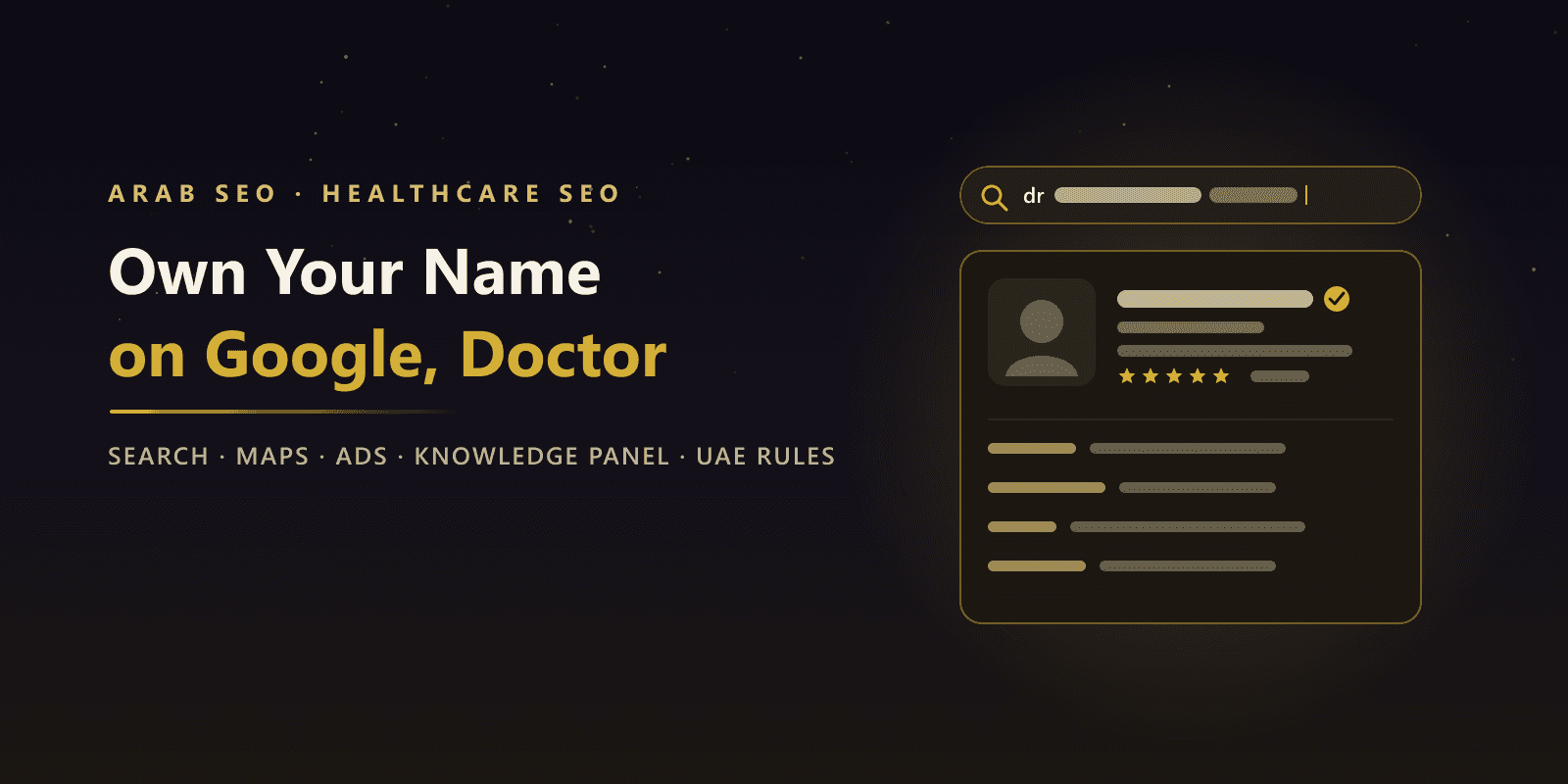
A patient is referred to you by a friend, or sees your name on a prescription, or hears it at a dinner. The next thing they do is type it into Google. What comes back decides whether they book: your page, or a booking platform's version of you with the wrong title, or a doctor in Cairo with the same name. For most doctors in the UAE that search is the most valuable page on the internet, and almost nobody manages it.
Quick answer: you do not "advertise" your name so much as take possession of it. Use the exact name and title on your licence everywhere; build one profile page on the clinic site with Person and Physician structured data and your licence number on it; set up a verified Google Business Profile in your own name under Google's practitioner rules; claim the booking-platform listings and the knowledge panel once it appears; collect reviews in a way the DHA allows; and only then run a small search ad on your name, with the health advertising permit in hand. The ads are the last step, not the first.
This is the sequence we run for doctors, dentists and surgeons in Dubai and Abu Dhabi, with the rules that govern each step, because in healthcare the rules are what get a licence holder into trouble.
What a patient sees when they search your name
Search your own name now, in a private window, from a phone. The page you see is made of perhaps eight kinds of result, and the useful way to read it is by who controls each one.
Two of those slots deserve a word before the steps. The knowledge panel, the card on the right of a desktop search and at the top of a phone, is not something you submit. Google builds it from its Knowledge Graph when it is confident an entity exists and knows enough about it, which is why a doctor with twelve consistent sources has one and a better doctor with none does not. And the search ad at the top is available to anyone willing to pay for the click, including the clinic across the road, which is the reason the ad is on this list at all.
Step 1: One name, one title, everywhere
Google identifies people the way a careful receptionist does, by matching details across sources. Every variation you give it is a reason to doubt that the sources describe the same person.
The reference is the licence. Dubai Health Authority, the Department of Health in Abu Dhabi and MOHAP each license you under a specific name and a specific title, and the DHA's own verification service lets anyone check a professional by licence number or DHA unique ID, which is an argument for publishing that number. If the licence says Specialist, the website cannot say Consultant, a point our guide to DHA advertising rules covers in detail; for the purpose of this page the point is narrower: the title on the licence, the website, the Business Profile, the booking platforms and LinkedIn must be the same word.
| Element | Pick one and keep it | Where it goes wrong |
|---|---|---|
| Name | The licence name in full, with "Dr" where you use it | Website says Dr. Ahmad Al Sayed, LinkedIn says Ahmed Alsayed, booking site says Dr. A. Sayed |
| Title | The licensed title: Consultant, Specialist, General Practitioner | "Consultant" on the site, "Specialist" on the licence |
| Specialty wording | One phrase, e.g. "Consultant Plastic Surgeon" | "Cosmetic surgeon" on one page, "aesthetic doctor" on another |
| ★ Arabic spelling | One transliteration, used on every Arabic page and profile | د. أحمد السيد on the site and الدكتور احمد سيد on the platform |
| Photograph | One current professional portrait, reused everywhere | Five photographs of different ages, one of them the clinic logo |
| Clinic association | Current clinic only; old clinics removed or marked former | A listing at a clinic you left in 2021 still ranking third |
Step 2: A profile page Google can trust
The page that should rank first for your name is a page about you on your clinic's website, at an address that will not change when the site is redesigned. Google's own guidance on helpful content asks whether it is "self-evident to your visitors who authored your content", wants bylines that lead to background on the author, and says that for topics affecting health, "the content must be highly accurate and consistent with established expert consensus". A doctor's profile page is where all three of those are proven.
| On the page | Why it is there |
|---|---|
| Licensed name, title and specialty in the heading | The query it must match |
| Qualifications with awarding bodies and years | Verifiable, and the detail assistants quote |
| Licence number and the regulator | Lets a patient verify you in a minute; a trust signal nobody fakes |
| Hospital and clinic affiliations | Ties your entity to entities Google already knows |
| Conditions and procedures, in plain language | The non-name searches that find you |
| Consulting days, locations and booking link | The conversion |
| Publications, talks, memberships | Third-party evidence of expertise |
| ★ Person and Physician structured data | The machine-readable version of all of the above |
The structured data matters more than it looks. Schema.org's Physician type carries medicalSpecialty, hospitalAffiliation and availableService, and inherits name, image, address, telephone, memberOf, hasCredential and sameAs. The sameAs links, pointing to your LinkedIn, booking-platform and professional-body profiles, are how you tell Google that the twelve sources are one person. Mark the clinic up as the organisation and you as a Person who works there, and the two reinforce each other. The page should be written in the first person or by a named colleague, carry a photograph that is actually you, and avoid the superlatives the DHA forbids anyway.
Step 3: Your own Business Profile, under the practitioner rules
Google Business Profile is built for businesses, but its guidelines make specific room for individual practitioners: doctors, dentists, lawyers and others who are public-facing and "can be contacted directly at the verified location during stated hours". The rules that follow from that are precise, and clinics break them constantly.
| Your situation | What Google's guidelines allow | Name on the profile |
|---|---|---|
| One of several doctors at a clinic | The clinic has its profile; you may have your own | Your name only, with your title. Not the clinic's name |
| The only public-facing doctor at a branded clinic | One shared profile for both | "Clinic Name: Dr Your Name" |
| Several specialties | One profile. Multiple profiles for specialisations are not allowed | Your name; specialties go in categories |
| Consulting at two clinics | A profile at each location where you can be contacted during its hours | Your name at both, with different addresses |
| Support staff, nurses, coordinators | No individual profile | — |
Verification and the rest of the set-up, including the video Google will ask for, follow the same process as any business and are covered in our guide to getting on Google Maps in Dubai. Two practitioner-specific points: pick the most specific category Google offers for your specialty rather than "Doctor", and keep the opening hours to the hours you actually consult there, because a profile that says you are available at 11pm contradicts the clinic's and costs both of you trust.
Step 4: Claiming the knowledge panel
When the panel appears, claim it. Google's verification process is short: search for yourself, choose "Claim this knowledge panel" at the bottom of the card (on a phone, from the menu), review the information, and sign in to an official account Google already associates with you, which can be Search Console for the clinic site, YouTube, Facebook or X. Not every panel is claimable yet, so check periodically. Once verified you can suggest corrections through the Feedback link beneath the panel, with links to the evidence, and add a manager at the clinic so the panel does not depend on one person's login.
What you cannot do is write the panel. Google composes it from what it has read, which brings the first three steps back: the fastest way to change what the panel says is to change what the sources say, consistently, and wait.
Step 5: Reviews, within the rules
Patients read reviews the way they read any other reviews. BrightLocal's 2026 survey of 1,002 US consumers found 47% would not use a business with fewer than 20 reviews and 31% would only consider one rated 4.5 or higher; there is no UAE equivalent, but nothing about Dubai patients suggests they are less demanding. Reviews on your practitioner profile belong to you and travel with you; reviews on the clinic's profile stay with the clinic. Both matter, and the request at the end of a consultation should make clear which is which.
The constraint is regulatory. What a clinic may do with testimonials, before-and-after material and patient stories is governed by the DHA's advertising standard, and the rules on soliciting and publishing them are stricter than in retail; the DHA guide linked above sets them out, and the safe practice is to ask for an honest review, never for a favourable one, and never to republish a review in a way that discloses a patient's treatment.
Step 6: Advertising on your own name
Now the step the question usually starts with. A search ad on your own name is cheap, because nobody else bids much on it, and it is worth running for three reasons: it takes the top slot before a competitor does, it lets you choose the page the patient lands on, and it shows you, in the ad statistics, how many people search for you each month.
| Question | The rule, as read in October 2026 |
|---|---|
| Do I need a permit? | In Dubai, health advertising needs the DHA's advertising permit; the clinic's existing permit process applies to a campaign on a doctor's name as to any other |
| Can I bid on my name? | Yes. Google does not restrict the use of names or trademarks as keywords |
| ★ Can a competitor bid on my name? | Also yes. Google restricts a trademark only in a competitor's ad text, and only for registered marks; a doctor's name is rarely one |
| What can the ad not say? | Google's healthcare policy bars prescription drug terms and speculative or experimental treatment claims, and does not list the UAE among places where prescription-drug or online-pharmacy promotion is permitted |
| Can I remarket to people who visited my page? | No. Health is a sensitive interest category; advertiser audiences such as remarketing lists and Customer Match cannot be used for it |
| Where should the ad send people? | Your profile page, with booking one tap away. Never the clinic home page |
The full healthcare policy is on Google's advertising policies site and changes by country and by year; the DHA layer sits on top of it, not instead of it. Keep the ad text to who you are, what you treat and where you consult, which is also what the DHA permits and what a patient searching your name wants to read.
Step 7: Booking platforms, LinkedIn and the assistants
The platforms patients already use, Okadoc and HeliumDoc among them in the UAE, rank well for doctors' names because they have thousands of them. Claim your listing on each, correct the title and the photograph, and keep the consulting hours current; an outdated platform listing will outrank a perfect page on a site nobody links to. LinkedIn is the one social profile that reliably ranks for a professional's name, and it needs the same name, the same title and the same photograph as everything else.
The newest reader of all of this is an AI assistant. Patients now ask ChatGPT or Gemini "who is Dr X" and "is Dr X good for rhinoplasty", and the answer is assembled from the same sources: your profile page, the platforms, the publications, the reviews. There is no separate trick for it: a doctor whose sources agree gets described accurately, one whose sources conflict gets a hedge or a namesake. Ask the assistants about yourself every quarter and fix the errors at the source.
What a consistent identity is worth: a Dubai plastic surgery practice. An anonymised Jumeirah 2 practice, one consultant surgeon, from August 2024. The site had no structured data; we marked up the clinic, the surgeon and the procedures, with DHA licensing, fellowship credentials and hospital affiliations in the schema, and rewrote 37 claims that breached Google's healthcare policy or DHA rules. By July 2026 consultation requests had gone from 18 to 76 a month, the share arriving from outside the UAE from 22% to 41%, and the surgeon's practice was cited in 19% of a 120-query panel of AI Overview and assistant answers, from zero. The figures are in the PS-19 case study.
When the name search has already gone wrong
Three situations come up often enough to name. A namesake who outranks you, usually a doctor abroad with more publications: the fix is more of steps one to three, plus a middle name or the specialty in the page title, so that the query itself separates you. A former clinic still listing you: ask them to remove you, and if they will not, suggest the edit to Google on their profile and make sure your current listings are stronger. A negative or false review: respond once, professionally and without clinical detail, flag it through the platform's policy route if it breaks the rules, and never let a dispute become the second result for your name. What the UAE's law offers against a demonstrably false review is a separate guide.
The twelve-week plan
Worked example: a dermatologist moving clinics. Illustrative. Dr Layla, a Specialist Dermatologist, leaves a Jumeirah polyclinic for a new practice in Dubai Hills. Week one: the licence title is confirmed, the Arabic spelling fixed, the old clinic asked in writing to remove her page. Weeks one to four: a profile page on the new site with licence number, qualifications, Person and Physician markup, and a booking button. Weeks two to five: a practitioner Business Profile at the new address, verified by video, with the dermatology category rather than "doctor". Weeks three to six: Okadoc, HeliumDoc and LinkedIn updated to the new clinic and the same portrait. Week four onward: a review request in the discharge message, pointing to her own profile. Week six: a search ad on her name under the new clinic's DHA permit, landing on the profile page. By week twelve the old polyclinic's page has dropped to the second page, and the knowledge panel shows the new address.
How we do this for doctors
Most of our healthcare work is for practices, and the practitioner's name is where it starts: the entity has to be right before anything built on it ranks. For an individual doctor we audit every mention of the name and title against the licence; write and mark up the profile page; set up or repair the practitioner Business Profile; file the knowledge panel claim and the booking-platform corrections; build the compliant review request into the clinic's discharge flow; and, when the permit allows, run the name campaign with the landing page it deserves. For dental groups the same work runs doctor by doctor on top of the dental SEO programme; for surgeons it is the foundation of our plastic surgeon SEO work, and the same desks cover dermatology, fertility, aesthetics and the other specialties where a patient chooses a person before a place.
Frequently asked questions
How do I get my name to show up on Google as a doctor?
Give Google one consistent identity to find: the exact name and title on your licence, used on a dedicated profile page on your clinic website, on a verified Google Business Profile in your own name, on the booking platforms patients use and on LinkedIn. Add Person and Physician structured data to the profile page, publish your licence number so it can be checked, and ask satisfied patients for reviews. Google assembles the first page from those sources, and the knowledge panel usually follows once they agree.
Can a doctor have a Google Business Profile separate from the clinic?
Yes. Google allows individual practitioners such as doctors and dentists to have their own profile if they are public-facing and can be contacted directly at the verified location during its stated hours. The practitioner profile carries only the doctor's name, with a title such as Dr., not the clinic's name; a solo practitioner who is the clinic's only public-facing doctor should instead share one profile named in the format "Clinic: Dr Name".
How do I get a Google knowledge panel as a doctor?
You cannot order one; Google creates it when it is confident about who you are, and you raise that confidence with a profile page, consistent listings, structured data and third-party mentions. Once a panel exists, search your own name, use the "Claim this knowledge panel" option and verify through Search Console, YouTube, Facebook or X. After verification you can suggest corrections through the Feedback link under the panel.
Can I run Google Ads on my own name as a doctor in the UAE?
Yes, with two conditions. Health advertising in Dubai needs the DHA advertising permit the clinic already uses for other campaigns, and the ad must obey Google's healthcare policy: no prescription drug terms, no speculative or experimental treatment claims, and no remarketing audiences, because health is a sensitive interest category. Clicks on your own name are cheap; the ad's job is to send the patient to your profile page rather than a competitor's.
Can another clinic advertise on my name?
They can bid on it. Google does not restrict the use of other people's names or trademarks as keywords; it only restricts trademarks appearing in a competitor's ad text, and only where the owner holds the trademark. The practical defence is to own the organic results so thoroughly that a competitor's ad sits above a page that is entirely about you, and to run a small ad on your own name so the top slot is yours too.
What should a doctor's profile page include?
Your licensed name and title, specialty and sub-specialties, qualifications with the awarding institutions, hospital affiliations, languages, the conditions and procedures you treat, where and when you consult, how to book, a professional photograph, your DHA, DoH or MOHAP licence number, and links to your other profiles. Mark it up with Person and Physician structured data, and keep claims to what the licence and the evidence support.
The patient who searches your name has already decided to consider you. Everything above is about making sure the page they find is yours, says what the licence says, and makes the next step one tap. If you would like us to run the audit on your own name, send us the name as it appears on your licence and the clinic you consult at, and we will come back with what currently ranks, what is wrong with it, and what we would fix first.