Most Dubai clinics discover the advertising rules the same way: a marketing executive schedules a before-and-after carousel on a Thursday, it performs well, and three weeks later somebody senior asks who approved it. Nobody did. The rules were not hidden — they run to twenty-eight pages on the DHA website — but almost nobody in the marketing chain has read them, and the person legally carrying the risk usually is not in the chain at all.
Quick answer: every advertisement for a regulated health service in Dubai must be accurate, substantiated and accompanied by its risks; the Medical Director is accountable for the content and style of everything that promotes the facility; the twenty-odd absolute words in clause 6.11 — best, safest, unique, 100%, guaranteed, immediate results — are off the table; before-and-after images require the same patient, the same lens, no retouching, written consent and a disclaimer in the same font size as the rest of the post; and the facility is liable for anything filmed on its premises even when it appears on an influencer's personal account.
This is a practical read of the rules for the people who actually run clinic marketing. Everything below is tied to a clause number so your Medical Director can check it against the source rather than taking our word for it. We are a search agency, not your lawyer — treat this as a map of the terrain, then have your clinical governance lead confirm the details before you change anything.
The document you are actually governed by
The controlling text is the DHA's Standards for Medical Advertisement Content on Social Media, code DHA/HRS/HPSD/ST-21, version 1.1, issued 3 August 2022 and effective from 3 October 2022, with a revision due in 2027. It applies, in its own words, to "all DHA licensed health facilities and healthcare professionals engaged in" social media advertising — clause 4.1, and note that it captures individual practitioners as well as facilities.
Two structural things are worth understanding before the detail. First, this is a content standard, not a permit queue: it sets what may be said and who signs it off internally. Your facility separately holds a healthcare advertisement licence, and clause 5.2 requires the official account of the health facility to state the medical advertisement licence number issued by the Ministry of Health and Prevention — the service sits on the MOHAP portal. Clinics routinely have one and display neither the number nor any awareness of it.
Second, the standard is deliberately not exhaustive. It says so itself: it "does not detail specific scenarios, but rather sets out the parameters of good" practice. That means a post can comply with every named rule and still be a violation if it misleads. Marketing teams hunting for loopholes in the wording are solving the wrong problem.
Who is actually on the hook
Clause 5.5 is the one that changes how you brief agencies. The facility is liable for all content filmed within its premises — "professionally or by personal devices such as mobile phones" — and that liability follows the content whether it is published by the facility, by a healthcare professional, or by a social media influencer on a personal account. An influencer filming a treatment in your chair is your compliance problem, contractually and clinically.
The converse is in 5.6: a healthcare professional promoting only their own service, without naming the facility or its location, carries that content themselves. And 5.7 catches visiting doctors — if a practitioner also works abroad, the Dubai-facing account must be separate, and any patient images from elsewhere used on it must still meet the Dubai standard.
The words clause 6.11 takes away from you
This is the fastest audit you can run on your own website and feed. The standard prohibits absolute statements, exaggerated claims and alarming expressions, and then names them.
| What marketing writes | Why it fails | What survives review |
|---|---|---|
| "Dubai's best dental clinic" | "the best" is named in 6.11; superiority claims also breach 8.1.9 | "Rated 4.6 from 300+ verified patient reviews" |
| "100% safe, no side effects" | Both "100%" and "has no side effects" are named; 6.6 requires risks | "Common side effects include… discuss suitability at consultation" |
| ★ "Immediate results, guaranteed" | "immediate results" and "assured success" named; Appendix 2 item 3 bans guaranteed recovery | "Most patients see change within X weeks; results vary" |
| "The only clinic in Dubai offering…" | "the only", "exclusive", "unique" all named | "One of the few clinics in Dubai with… (verifiable fact)" |
| "Limited slots — book today!" | "very limited quantity" named; Appendix 1 (m) covers time-limited inducements | "Consultations currently available this month" |
| "Money-back if you're not happy" | "get money back" named | State your actual, honoured policy without framing it as an inducement |
| "Miracle treatment" | "magic", "miraculous" named; Appendix 1 (n) bans infallible or magical claims | Describe the mechanism and the evidence |
The full list in 6.11 also includes one of a kind, safest, incomparable, unprecedented, best product, absolutely certain, distinguished, famous and pioneer. Clause 6.12 adds that negative statements about another professional, facility or government entity are not acceptable — which rules out the comparison posts that periodically go around aesthetic Instagram.
Before and after: allowed, but not the way most clinics do it
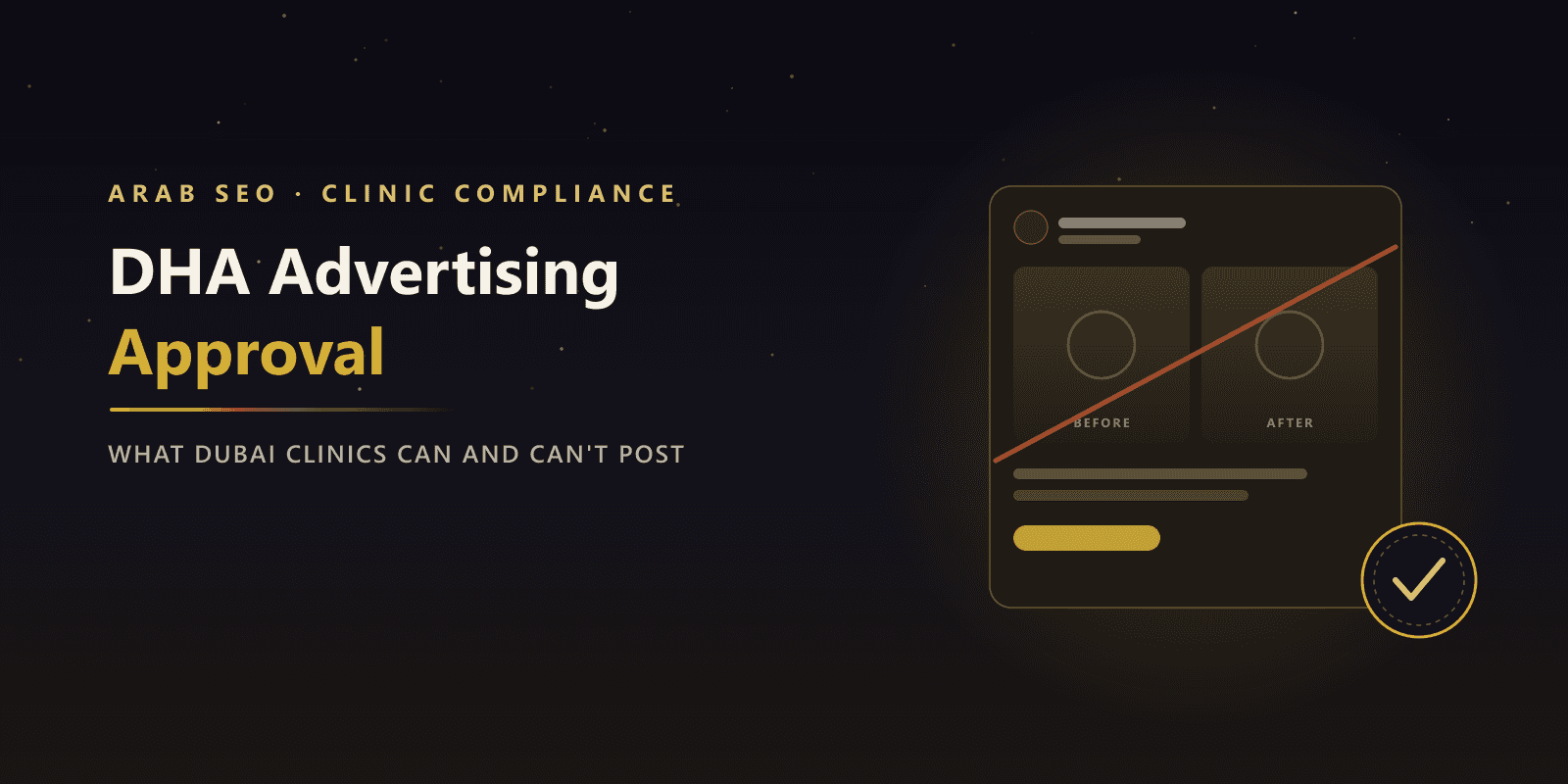
Clinics often believe before-and-after imagery is banned outright. It is not. Clause 9.6 permits it under conditions that are, in practice, stricter than a ban would be for anyone improvising:
- Same individual in both frames — no composites, no stock "after".
- Same lens. Changing focal length between shots is itself the violation, which quietly outlaws the flattering-angle version of the genre.
- No Photoshop or equivalent software enhancement.
- A statement that the result is not guaranteed to be the same, together with the risks.
- In the same font size as the rest of the advertisement. Fine print fails; clause 7.1.5 separately requires fine print to be prominent and legible.
Layer on Appendix 2 item 12, which requires a disclaimer that outcomes vary and states that visual images "must only represent patients who have received the treatment", and item 8, which prohibits patient testimonials without written consent. Then clause 6.10: consent must be documented, limited to the subject it was requested for, and limited to the period granted. A consent form signed in 2023 for a single campaign does not cover a 2026 reel.
Clause 9.7 draws a hard line elsewhere: no video filming or live streaming for advertising while a patient is undergoing minor or major surgery, under general anaesthesia, or in procedure rooms. Appendix 2 item 14 repeats it. The operating-theatre content format that does well on TikTok is simply not available to a DHA-licensed facility.
Titles: the violation hiding on your team page
Clause 6.1 prohibits using names or specialty titles different from the DHA licence, and it names the offenders: Cosmetic Specialist or Consultant, Aesthetic Specialist or Consultant, Aesthetician, Cosmetologist, Diet Specialist or Consultant, Beauty Specialist or Consultant, Anti-Aging Specialist or Consultant, Cosmetic or Beauty Expert. Clause 8.1.3 requires professionals to state name, title, professional qualification and specialty as per their DHA licence.
We find this on roughly every second clinic website we audit, and almost never on the social accounts anyone worries about — it is on the team page, written years ago by a web designer who thought "Aesthetic Consultant" sounded better than "Specialist Dermatologist". It is also the easiest thing on this list to fix in an afternoon. If you run an aesthetic clinic, start there before you touch your Instagram grid.
One more in the same family: clause 6.3 requires PhD holders working in or managing a facility to have their certificates attested and recognised by the UAE Ministry of Education, and 7.2 forbids using the DHA name or logo — or any government authority's — without explicit written approval. The "DHA Approved" badge some clinics add to their footer is not the reassurance they think it is.
The fourteen prohibitions, in plain language
Appendix 2 lists content that is prohibited outright. Condensed, with the marketing translation:
| The standard prohibits | What that means in practice |
|---|---|
| Treatments guaranteeing full recovery | No "permanent solution" or "complete cure" framing |
| Trial usage of medical products or services | No "try your first session free" mechanics |
| Content that commercially harms other providers | No competitor comparisons, however factual they feel |
| Patient-identifiable information | Faces, names, files, recognisable rooms — all consent-gated |
| ★ Unrealistic or absolute effectiveness claims | The single most common violation we see |
| Testimonials without written consent | Get it in writing, scoped and dated |
| Unproven comparisons between treatments | Allowed only with peer-reviewed support and citations |
| Fear, anxiety or panic-inducing language | No "silent killer" hooks in health awareness posts |
| Claims of exclusive or unique skill | Your doctor may be excellent; they may not be "the only" |
| Missing "results vary" disclaimers | And images only of patients who had the treatment |
| Unfounded claims against others or government | Including in comment replies, which are content too |
| Surgical filming under general anaesthesia | No exceptions for "educational" framing |
| Tattooing, profanity and nudity | Read alongside 9.4.5 on intimacy and sex appeal |
| Products scientifically proven harmful | And, per 6.8, anything unproven or non-therapeutic |
What you are positively allowed to say
Compliance content usually stops at the prohibitions, which leaves marketing teams frozen. Appendix 1 lists what is explicitly acceptable, and it is a decent content brief in disguise: a factual, clear statement of services; contact details and office hours, including after-hours availability; the gender of practitioners; languages spoken in the clinic; fees, insurance arrangements and instalment plans; the schools and training programmes your clinicians graduated from, with qualifications; specialist registration recognised by DHA; current or former teaching positions with dates; accreditation of the practice; peer-reviewed publications; non-enhanced photographs of the professional or the office; and public health information that is evidence-based.
Read that list again as an SEO brief and it is almost exactly what a good clinician page should contain — credentials, languages, insurance, fees, availability. The regulator is pushing you toward the content that converts anyway: patients searching for a Dubai dentist want to know whether you take their insurance and whether anyone speaks their language, not whether you are "world-class".
The approval workflow that survives an inspection
The standard asks for more governance than most clinics have. Clause 7.1.8 requires a nominated, trained person to moderate social content. 7.1.9 requires staff training at induction with refreshers. 7.1.10 requires a documented social media policy that employees know about. 7.1.11 requires the penalties to be communicated to staff. And 7.1.13 requires posts to be archived with edits and formats, because the Health Regulation Sector may audit content against Appendices 1 and 2.
Two more that catch people: 7.1.2 requires clinicians to keep personal and professional accounts separate and to avoid interacting with current or past patients on personal accounts — a rule that collides with how doctors actually use WhatsApp and Instagram. And 7.4 prohibits featuring patients who received services in DHA-based facilities on international accounts, which matters for groups running a global brand page.
Where this bites on your website and search presence
The standard is written for social media, but the same content governs your site, your ads and your listings — and search is where the claims are most durable. Practical mapping:
| Surface | The usual violation | Fix |
|---|---|---|
| Treatment pages | Outcomes claimed, risks absent | Add a risks and suitability section to every page (6.6) |
| Doctor bios | Titles that differ from the DHA licence | Mirror the licence wording exactly (6.1, 8.1.3) |
| Homepage banners | "Best", "safest", "100%" | Replace with verifiable, sourced facts |
| Offers and pricing | Countdown discounts, free trials | Publish accurate prices with conditions (Appendix 1 m) |
| Google Business Profile | Keyword-stuffed name, promo posts | Licensed name only; keep posts factual |
| Review replies | Confirming a patient's treatment publicly | Never confirm attendance or clinical detail in a reply |
| Schema markup | aggregateRating on treatment pages | Only where ratings are genuine and permitted |
The review-reply row deserves emphasis because clinics get it wrong daily. A public reply that says "thank you for trusting us with your implant procedure" confirms that a named person was your patient. That is patient-identifiable information disclosed by you, not by them. Reply warmly, thank them for the feedback, and say nothing about what they had done — the same discipline we apply when running local SEO review programmes for clinics.
Case study — Rimal Dental Studio, Jumeirah 1. A dental clinic that treated compliance as the starting point rather than a blocker: every treatment page written with clinical sign-off, indicative price ranges framed carefully, no before-and-after claims, and a review engine built on a QR flow at reception instead of on testimonials. Between January 2025 and July 2026, organic sessions went from 740 to 4,120 a month, new-patient calls from 24 to 86, the map pack position for "dentist jumeirah" from #9 to #1, and cost per consultation from AED 210 to AED 62. The detail is in the Rimal Dental case study, and the same approach underpins our work with Lumea Aesthetics.
Worked example — one caption, rewritten. Illustrative. Before: "✨ DUBAI'S BEST LIP FILLER ✨ 100% safe, immediate results, no downtime! Limited slots this week — DM to book. Swipe for before & after 👉". That single caption breaches 6.11 four times, promises a guaranteed outcome, omits risks, uses a time-limited inducement and carries unlabelled before-and-after imagery. After: "Dermal filler consultations with Dr [Name], Specialist Dermatologist (DHA licence [number]). Filler is a medical procedure with risks including swelling, bruising and, rarely, vascular complications — we assess suitability at consultation. Results vary between patients. Consultations available this month; call [number]." Less exciting, still marketing, and it will not cost the Medical Director their evening.
What most clinics get wrong
- Treating the website as out of scope. The claims that survive longest live on your service pages, not in a story that expires in 24 hours.
- Letting the agency approve clinical claims. No agency, ours included, can carry clause 7.3 for you.
- Consent collected once, used forever. Clause 6.10 scopes consent to purpose and period.
- Deleting instead of archiving. 7.1.13 expects a record, and a deleted post is not a defence.
- Assuming an influencer's permit covers you. It covers their advertising obligations, not your clinical ones.
- Writing risks in smaller type. 9.6 requires the same font size; 7.1.5 requires prominence.
A note on currency. Everything above is taken from version 1.1 of the standard, which carries a revision date of 3 August 2027. DHA also issues circulars that tighten enforcement between revisions, and the northern emirates and Abu Dhabi are governed separately by MOHAP and the Department of Health. Before you rewrite anything material, have your Medical Director confirm the current text and any circulars applying to your facility type.
Frequently asked questions
Do Dubai clinics need DHA approval for every social media post?
Every post that advertises a regulated health service needs to go through your facility's approval process, and the Medical Director is accountable for its content and style under clause 7.3. That is an internal sign-off obligation, distinct from the healthcare advertisement licence your facility holds. Posts that are purely administrative — public holiday hours, a new phone number — are not medical advertisements in the same sense, but anything touching a treatment, outcome or price is.
Can a Dubai clinic post before and after photos?
Yes, within strict limits. Clause 9.6 requires the images to be of the same individual, taken with the same lens, with no Photoshop or equivalent enhancement, and accompanied by a statement that the result is not guaranteed to be the same, together with the risks — written in the same font size as the rest of the advertisement. Written, documented patient consent is mandatory, and the consent is limited to the purpose and period for which it was given.
Which words are banned in Dubai medical advertising?
Clause 6.11 lists absolute and exaggerated terms that must not be used, including unique, one of a kind, the best, exclusive, safest, the only, incomparable, unprecedented, magic, miraculous, assured success, has no side effects, get money back, 100 per cent, absolutely certain, distinguished, famous, pioneer and immediate results. The principle behind the list matters more than the list: any claim implying a guaranteed or superior outcome is a problem.
Can our aesthetic doctor be called an "aesthetic consultant" online?
Only if that is the title on the DHA licence. Clause 6.1 specifically names titles that cannot be used when they differ from the licence, including Cosmetic Specialist or Consultant, Aesthetic Specialist or Consultant, Aesthetician, Cosmetologist, Diet Specialist or Consultant, Anti-Aging Specialist or Consultant and Beauty Expert. Clause 8.1.3 requires the name, title, qualification and specialty to match the licence exactly — which makes your website bio pages a compliance surface, not just a marketing one.
Are patient reviews and testimonials allowed?
Unsolicited Google reviews written by patients on Google's own platform are their speech, not your advertisement. What the standard restricts is testimonials you publish as marketing: Appendix 2 prohibits patient testimonials without written patient consent, and Appendix 1 treats testimonials comparing different regulated health professions as unacceptable. The practical line is that collecting genuine reviews is fine and encouraged; republishing them as promotional claims about outcomes is where clinics get into trouble.
Who gets penalised if an influencer posts something non-compliant from our clinic?
The facility. Clause 5.5 makes the health facility liable for all content filmed within its premises, professionally or on a mobile phone, whether it appears on the facility's account, a professional's account or an influencer's personal account. Since February 2026 the influencer also needs their own UAE advertiser permit, but that permit covers their advertising obligations — it does not move the clinical advertising liability off your Medical Director.
The clinics that market best in Dubai are not the ones taking the most risk — they are the ones that stopped arguing with the rules and built their content around what they are allowed to say, which turns out to be credentials, evidence, languages, insurance and honest pricing. That is also what patients search for. If you want your treatment pages and doctor bios audited against this standard and rebuilt so they rank without putting your licence anywhere near the line, talk to us — we work alongside your Medical Director, not around them. If you run a dental practice, that audit usually pays for itself in the first quarter.