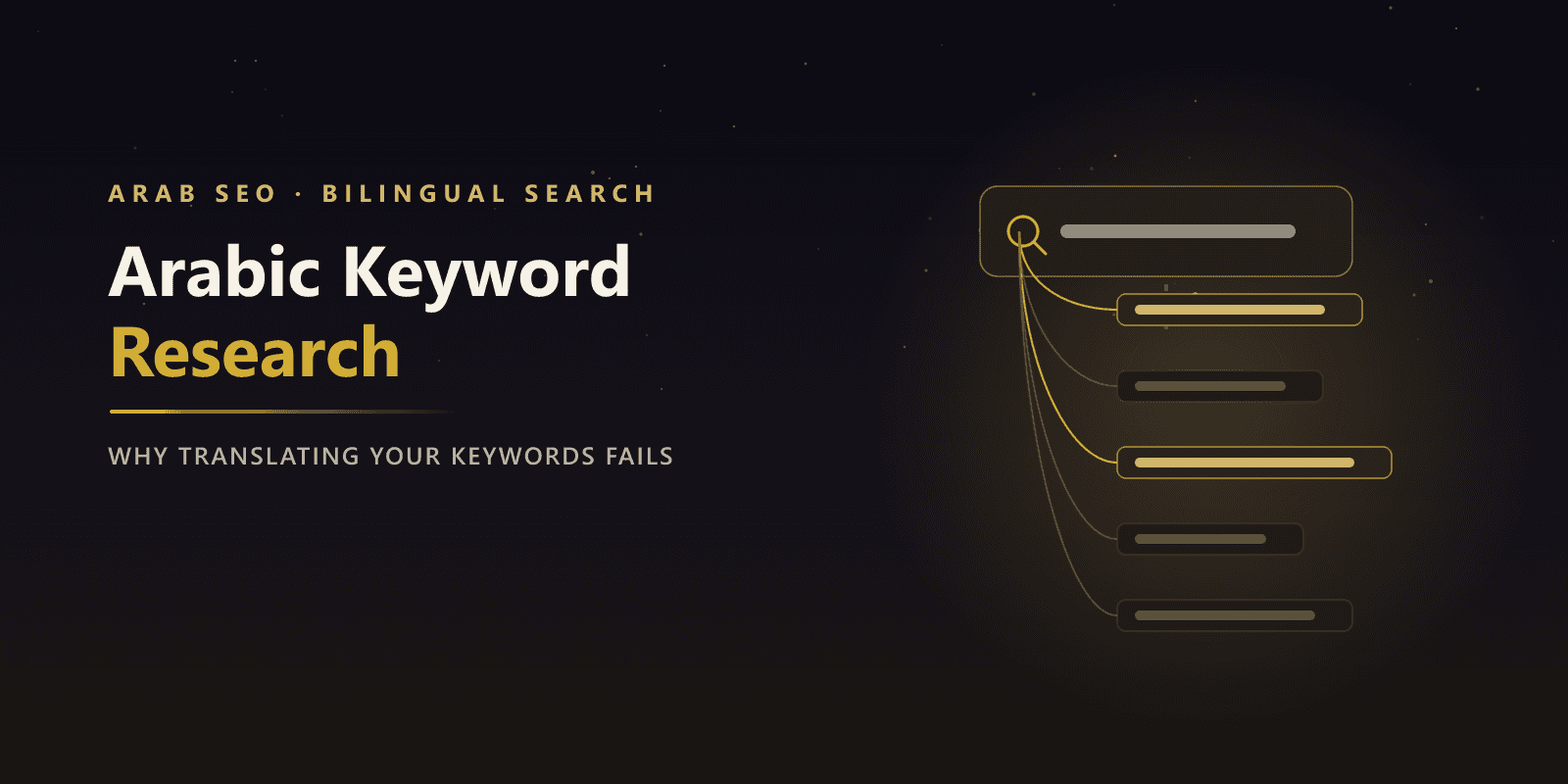
It usually arrives as a spreadsheet. Someone exports the English keyword list, runs it through a translator or hands it to a bilingual colleague for an afternoon, and the Arabic column comes back filled in. The pages get built, the hreflang tags go on, everyone waits — and the Arabic site never ranks for anything that matters. Not because Arabic SEO is hard, but because that spreadsheet was never a keyword list. It was a vocabulary list.
Quick answer: translation gives you the formal Modern Standard Arabic term for a concept. Search gives you the shorter colloquial form people actually type, several spellings of it, queries that mix Arabic with Latin-script brand and place names, and occasionally three separate services hiding inside one English word. Real Arabic keyword research starts from what Arabic speakers type, not from what your English keywords mean.
This is the process our Arabic team runs before writing a single page. It matters commercially, not just linguistically: Arabic is roughly 5% of the world's internet users but well under 1% of its web content, according to W3Techs' survey of content languages. That asymmetry is the whole opportunity — in most Gulf categories the Arabic results are thinner and easier to beat than the English ones, provided you target what people search.
One English keyword is never one Arabic keyword
Look at the second row. The formal translation is not wrong — it is simply longer and more literary than what someone types with one thumb at 9pm when the air conditioning has failed. And look at the last row: تصليح مكيفات means repair, not maintenance. Same English source word, different service, different price, different page. A translated list hides that distinction completely.
The six ways translation fails
1. Register: formal Arabic is not search Arabic
Modern Standard Arabic is the language of writing; Gulf colloquial is the language of typing. The clearest case is the doctor: the correct formal term is طبيب أسنان, while an enormous share of real queries use دكتور اسنان — a borrowed word, in a casual register, that no translator would ever hand you. Both belong on the page. Only one of them will be in your spreadsheet.
2. Orthography: the same word, spelled several ways
Arabic writers routinely drop the hamza, write ة as ه, and swap ى for ي at the end of a word — and almost nobody types diacritics. So إيجار and ايجار arrive as the same intent, as do شركة and شركه. Search engines normalise most of this, which is good news: these are one keyword, not four. The mistake is treating them as separate targets and building four thin pages that compete with each other.
3. Script mixing: half the query is in Latin letters
Gulf users mix scripts inside a single query without thinking about it. Place names, brand names and technology terms routinely stay in Latin script inside an otherwise Arabic search — an apartment hunter types the Arabic for "apartments for rent" and then "Dubai Marina" in English. If your Arabic pages transliterate every proper noun into Arabic script, you have written yourself out of those queries.
4. Arabizi: Arabic in Latin characters
Arabizi — Arabic written in Latin letters, with digits standing in for sounds English lacks — is common among younger users and in messaging. It appears in search less often than people assume, but in some consumer categories it is real volume. Worth checking; not worth building a site around.
5. One English word, several Arabic jobs
This is where money is actually lost. "Cleaning" in English is one keyword; in the UAE market it is at least three businesses — villa cleaning, sofa cleaning and AC cleaning — each with its own demand, its own price and its own buyer. A single translated "cleaning services" page competes for all three and wins none. Three pages built on the real queries win all three.
6. Loanwords: transliterate, never translate
Some words arrived in Arabic from English or French and stayed. A translator will dutifully find you a classical Arabic equivalent; nobody searches for it. An aesthetic clinic's biggest terms are بوتوكس and فيلر — botox and filler, written in Arabic letters, not translated into Arabic words. A salon's is كوافير, from the French coiffeur, which outruns the textbook صالون شعر across the Gulf. The rule is simple and it catches out every translation workflow: if the thing itself came from abroad, the query is almost always the transliteration.
What translation gives you, and what people type
| English keyword | Literal translation | Also typed in the Gulf | What changed |
|---|---|---|---|
| dentist in dubai | طبيب أسنان في دبي | دكتور اسنان دبي | Colloquial word, hamza dropped, preposition dropped |
| ac maintenance | صيانة مكيفات الهواء | صيانة مكيفات | Shorter everyday form |
| cleaning company | شركة تنظيف | شركه تنظيف فلل | Spelling variant plus a specific service |
| apartments for rent | شقق للإيجار | شقق للايجار + Dubai Marina | Hamza dropped, place name stays in Latin |
| best restaurants dubai | أفضل المطاعم في دبي | افضل مطاعم دبي | Hamza dropped, article dropped, shorter |
Which differences merge, and which split
| Difference | Example | Treat as |
|---|---|---|
| Alef forms | إيجار / ايجار | One keyword — normalised |
| Ta marbuta vs ha | شركة / شركه | One keyword — normalised |
| Alef maqsura vs ya | مستشفى / مستشفي | One keyword — normalised |
| Diacritics | Rarely typed at all | Ignore — never require them |
| Register | طبيب / دكتور | One page, both words present |
| ★ Different service | تنظيف فلل / تنظيف كنب | Separate pages, always |
| Different country | UAE vs Saudi usage | Check volume per country, not per language |
Ten industries, ten different traps
The failure modes above combine differently in every sector. These are the ones we hit most often in UAE accounts — the pattern is worth reading even for the rows outside your industry, because the trap in someone else's category is often hiding in yours.
| Industry | English keyword | Literal translation | What they actually type | The trap |
|---|---|---|---|---|
| Real estate | apartments for rent | شقق للإيجار | شقق للايجار + Dubai Marina | Community names stay in Latin script |
| Real estate | off-plan property | no literal equivalent | عقارات على الخارطة | A market idiom, not a translation |
| Dental | dental implants | زراعة الأسنان | زراعة اسنان | Hamza dropped; دكتور beats طبيب |
| Aesthetics | botox, filler | do not translate | بوتوكس · فيلر | Loanwords: transliterate |
| Pest control | pest control | مكافحة الحشرات | رش مبيدات | Two valid terms, two registers — use both |
| Salon | hair salon | صالون شعر | كوافير | A borrowed French word dominates |
| Car repair | car repair | تصليح سيارات | ورشة سيارات | They search the place, not the action |
| Legal | law firm | مكتب محاماة | مستشار قانوني | UAE licences read "legal consultant" |
| Business setup | company formation | تأسيس شركة | رخصة تجارية دبي | They search the document, not the service |
| Perfume retail | perfume | عطور | عود + brand in Latin | Product term outsells the category term |
Real estate is the clearest case of script mixing. A buyer types the Arabic for apartments and then "Dubai Marina", "JVC" or "Business Bay" in English, because that is how the community is written on every sign and portal. Transliterate those into Arabic across your whole site and you disappear from the query. Worse, the highest-intent term in the market — عقارات على الخارطة, off-plan property — is an idiom no translator will hand you, because "off-plan" has no literal Arabic form.
Regulated sectors hide a different trap: the word the law uses is not the word the customer uses. Most UAE firms are licensed as legal consultancies, so their Arabic pages say مستشار قانوني while a worried customer searches محامي — lawyer. Both belong on the page: the licensed term for accuracy, the searched term in the heading and FAQ. The same split runs through clinics, where the licence says one thing and the patient types دكتور.
Business setup shows the deepest version of the problem, and it is not linguistic at all. Founders rarely search for the service; they search for the artefact they need — رخصة تجارية دبي, a Dubai trade licence — and for what it costs. A page built on the translated service name misses the entire demand curve sitting one step earlier in the journey.
The process that actually works
- Start with what you already rank for. Search Console holds the Arabic queries that found you before anyone planned for them. It is the only source that is unarguably real, and it is free.
- Take each English head term to a native speaker, not a translator. Ask what they would type, not what the term means. The two answers differ more often than not.
- Harvest autocomplete in Arabic. Type the colloquial stem into Google with the country set correctly and record every suggestion. Autocomplete is a record of real queries, which is exactly what a translation is not.
- Validate volume per country. Keyword Planner with the language set to Arabic and the location set to one country at a time. UAE, Saudi and Egyptian demand for the same word can differ by an order of magnitude — if you are planning Gulf expansion, this is the step our international SEO work lives on.
- Fold the spelling variants, split the intents. One page per intent, never one page per spelling.
- Write natively. A page written in Arabic reads differently from a page translated into it, and both readers and search engines can tell.
- Connect the two languages properly. Reciprocal hreflang between the English and Arabic versions, following Google's guidance for multi-regional and multilingual sites, so the right version is served rather than the two competing.
Where the keywords go once you have them
A correct keyword list still fails if it is dropped into a page built for English. Four things decide whether the research turns into rankings.
- Put the colloquial term where people read first. The title, the H1 and the opening sentence should carry the phrase people type; the formal term belongs in the body, where it signals professionalism without costing you the match.
- Let Arabic pages link to Arabic pages. The most common bilingual error we find is an Arabic page whose internal links all point at English URLs. It drops the reader into the wrong language and leaks the Arabic site's authority back to the English one.
- Write currency and numbers the way the reader expects. Prices stated as درهم rather than "AED", and digits rendered consistently with the rest of your Arabic site — mixing conventions inside one page looks machine-made, which is the impression you are trying to avoid.
- Check the layout, not just the text. Right-to-left is a layout change, not a translation setting: navigation, icons, form fields and anything anchored left or right has to mirror. Correct Arabic in a broken direction reads as an afterthought.
Which categories are actually searched in Arabic
Before committing budget, measure the split — it varies enormously by sector and decides how much the Arabic site is worth. In our experience across UAE accounts, home services, health, legal, government-adjacent and family topics skew heavily Arabic, while B2B software, corporate services and international luxury brands skew English even among fluent Arabic speakers. Consumer retail sits in the middle and shifts by season: gifting periods push queries toward Arabic.
The practical consequence is that "we should do Arabic SEO" is not a strategy. Arabic-first is right for a cleaning company and probably wrong for an enterprise SaaS platform selling to CTOs in Dubai Internet City. Measuring the split first is what our Arabic SEO team does before recommending a scope, and it occasionally ends with us recommending a smaller one.
Sizing the opportunity before you commit
You can estimate what an Arabic site is worth in an afternoon, using data you already own, before anyone quotes you for one.
- Filter Search Console by country for the last twelve months — UAE and Saudi Arabia separately — and look at the queries already arriving in Arabic script. Anything there is demand reaching you with no Arabic page at all.
- Run your five head terms through Keyword Planner twice, once in English and once in the colloquial Arabic form, with the location fixed to one country. The ratio between them is your language split for that category.
- Check who currently ranks for the Arabic terms. Thin pages and machine translations mean a short path to page one; strong native Arabic competitors mean a longer one.
- Multiply honestly. Arabic volume, times a realistic click share, times your conversion rate, times average order value. If that does not cover writing and maintaining the pages, the right answer is a small Arabic cluster on your highest-value terms — not a mirror of the whole site.
Case study — Founders Gate, Downtown Dubai. A company-formation consultancy whose Arabic cluster was built natively rather than translated, with AED-first pricing tables and reciprocal en-ae / ar-ae hreflang. Between February 2025 and July 2026, organic sessions went from 1,540 to 6,120 a month, qualified leads from 28 to 73, and cost per lead fell from AED 240 to AED 96. The same engagement is candid about what did not work — Hindi and Urdu leads converted at about half the English rate. The full file is in the Founders Gate case study.
Worked example — one page becomes four. Illustrative. A Dubai cleaning company has a single Arabic page translated from "cleaning services", ranking for nothing. The research finds four distinct demands: villa cleaning, sofa cleaning, AC cleaning and post-construction cleaning — four different jobs the English site had merged into one. Four native Arabic pages replace the one, each using the colloquial term in the heading and the formal term in the body, spelling variants left to normalisation. Nothing about the English site changes, and the Arabic site stops competing with itself.
The mistakes that cost the most
- Machine-translating the page as well as the keyword. Readers leave, and thin translated pages are exactly what Google is trying to filter out.
- Building a page per spelling variant. Three pages, one query, all three weakened.
- Translating proper nouns that people type in Latin script.
- Using one keyword set for the whole Arab world. Gulf, Levantine and Egyptian usage differ; so does volume.
- Bolting on a translation widget that generates no indexable Arabic URLs — a trap we cover in the Arabic section of our Shopify SEO checklist.
- Skipping hreflang, then wondering why the English page outranks the Arabic one for Arabic queries. Getting that wiring right across languages is the core of multilingual SEO.
Frequently asked questions
Can I just translate my English keyword list into Arabic?
No. A translation gives you the formal Modern Standard Arabic term, which is often not what people type. You will miss the shorter everyday Gulf form, the common spellings written without hamza, the queries that mix Arabic with Latin-script place and brand names, and the cases where one English word covers several distinct Arabic services. Translation is a starting point for research, never the output of it.
Should I target Modern Standard Arabic or Gulf dialect?
Both, in different places. Write the page in Modern Standard Arabic — it reads as professional across every Arab market and does not alienate anyone. Then make sure the dialect and colloquial forms people actually type appear naturally in headings, FAQs and body copy, because those are the queries. The formal register is how you write; the colloquial register is how they search.
Do Arabic spelling variants count as separate keywords?
Usually not. Search engines normalise the common orthographic differences — the alef forms, ta marbuta against ha, alef maqsura against ya, and omitted diacritics — so the variants behave as one query. Build one page, not one per spelling. Use the correct spelling in your own copy, and let the normalisation handle the rest.
What tools work for Arabic keyword research?
Google Keyword Planner is still the most reliable for volume if you set the language to Arabic and the location to the specific country, because demand differs sharply between the UAE, Saudi Arabia and Egypt. Supplement it with Arabic autocomplete and People Also Ask, your own Search Console query data — which already contains the Arabic people used to find you — and competitors' Arabic pages. Most third-party tools under-report Arabic badly.
Do Arabic speakers in the UAE search in Arabic or English?
It depends entirely on the category. Home services, health, government, legal and family topics skew heavily Arabic. B2B software, corporate services and international luxury brands skew English even among fluent Arabic speakers. That split is the first thing to measure, because it decides how much of your budget the Arabic site deserves.
Is Arabic search less competitive than English?
Generally yes, and the gap is structural: Arabic accounts for roughly 5% of internet users but under 1% of web content. In most Gulf categories that means fewer serious competitors, weaker pages at the top, and a realistic path to page one on terms that would take years in English.
Arabic search is the least contested real demand in this region, and the reason so few brands capture it is that they translated a spreadsheet instead of researching a language. If you want to know how much Arabic demand exists in your category — and whether it justifies a full Arabic site or four pages — ask us for the split. We will map your top English terms against what Gulf users actually type, per country, before anyone writes a word.