The licence is issued, the website is live, the launch post went out to three hundred LinkedIn connections and got forty likes. Nobody has paid. This is the most common place for a Dubai startup to be a month before or after launch, and the most common mistake at that point is to reach for the channel that scales, paid ads or SEO, before the business has learned who buys and why.
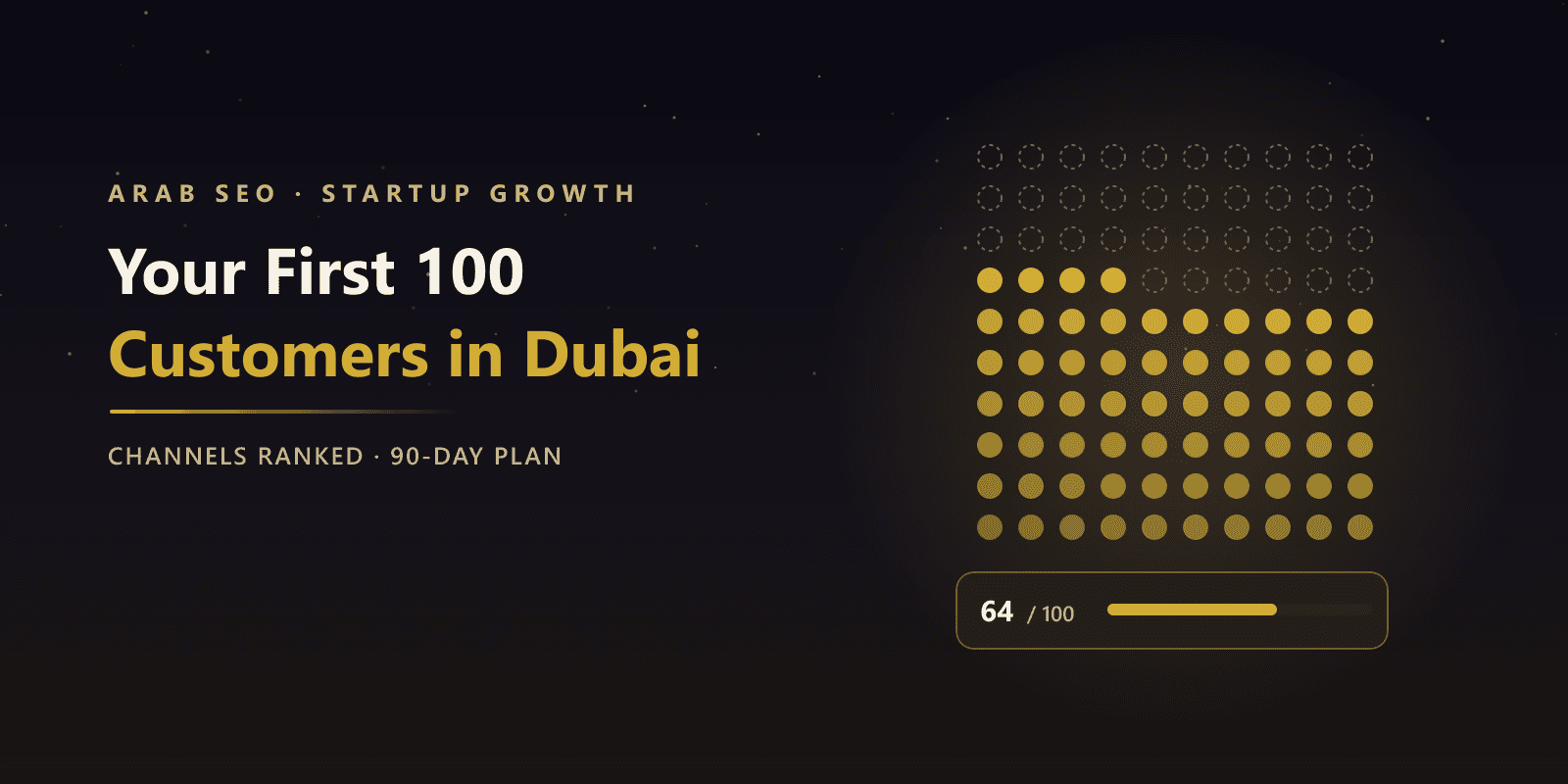
Quick answer: the first 100 customers of almost every Dubai startup are won by hand, in a predictable order. The first ten to twenty come from the founder's own network and direct outreach. The next thirty come from places buyers already gather: WhatsApp and community groups, LinkedIn for anything sold to businesses, partnerships with businesses that already have your customers, and a verified Google Business Profile for anything local. The last fifty come increasingly from referrals by the first fifty. Paid search and SEO start in month two, the first as a capped test to learn what a customer costs and the second because it takes months to build. Plan on thirteen weeks.
We work with Dubai founders at this stage regularly, and the pattern is consistent enough to write down. What follows ranks the channels by what they cost, how fast they produce a first customer and how far they can take you, and turns them into a 90-day plan with weekly numbers.
Why the first 100 are a different problem
Customers one to a hundred are not a smaller version of customers one thousand to ten thousand. They buy from a business with no reviews, no track record and no case studies, so they buy mostly because of who introduced them or how directly the founder answered their question. What you are really buying with the first hundred is information: who the customer is, what they were trying to do when they found you, which words they used, what they nearly bought instead, and whether they come back and bring someone. Every channel below should be judged on how quickly it produces that information as well as how many customers it produces.
Dubai adds two things. Almost everyone is reachable: the UAE has 11.4 million people and internet use of 99%, according to DataReportal's Digital 2026 report. And trust travels through communities more than through brands: residents' WhatsApp groups, nationality associations, school parent groups, industry circles, the same few hundred people at every event. A founder who is useful inside two or three of those communities will out-sell one with a bigger ad budget for the whole of the first quarter.
The channels, ranked
This is our ranking for a typical Dubai launch, judgement from working with founders rather than survey data. "Ceiling" is how far a channel can carry you before it runs out.
| Channel | Cash cost | First customer in | Ceiling | Best for |
|---|---|---|---|---|
| ★ Founder's network, one by one | Nil | Days | The first 10–20 | Everyone |
| WhatsApp and community groups | Nil | Days to weeks | Low to medium; burns out if you only sell | Local and consumer businesses |
| LinkedIn: founder posting plus direct messages | Nil | Weeks | Medium | Anything sold to businesses |
| Partnerships with complementary businesses | Revenue share or nil | Weeks | Medium to high | Services that sit next to an existing purchase |
| Google Business Profile | Nil | About a week to verify | High, for local searches | Anyone customers visit, or who visits them |
| Marketplaces and booking platforms | Commission | Days | High, but the customer belongs to the platform | Products, food, bookable services |
| Ecosystem programmes and events | Fees vary | Weeks to months | Medium; introductions, not sales | Tech and B2B startups |
| Creators | Fees, plus a permit check | Days | Medium, uneven | Consumer products with a visual hook |
| A capped paid-search test | A few thousand dirhams | Days | High later; the test buys information | Anything people already search for |
| Search and AI answers | Time and content | Months | The highest | Customers 100 to 1,000 |
Weeks 1–4: the founder's network, by hand
Write down every person you know who could buy, or who knows someone who could. In Dubai that list is longer than founders expect, because almost everyone here has worked in two or three companies and belongs to several communities. Message them one at a time, not in a broadcast. Say what you have built, who it is for and what you are asking for: a purchase, an introduction, or twenty minutes of honest feedback. The aim is five paying customers by the end of the second week and fourteen by the end of the month, and a written note from every conversation about why they did or did not buy.
Two rules make this work. Charge from the first customer, even at a launch price, because free users tell you very little about whether people will pay. And do the work for these customers yourself, so you hear the words they use; those words become your website copy, your ads and the questions your content will answer later.
Weeks 2–6: communities, LinkedIn and WhatsApp
Community groups are where Dubai residents ask each other for recommendations: building and community WhatsApp groups, parent groups, nationality associations, sports clubs, professional circles. They punish selling and reward usefulness. Join as a person, answer questions in your field for a few weeks, and let members ask what you do. A single recommendation from a trusted member of a community group is worth more than any number of posts.
For business buyers, LinkedIn is the equivalent. DataReportal counts 10.0 million registered LinkedIn members in the UAE; how many are active is another matter, but the decision-makers you want are there. What works for a new founder is plain: post what you are learning from customers, not what you are launching, two or three times a week, and send direct messages to the twenty companies you most want, each referencing something specific about them. WhatsApp Business, with a catalogue and quick replies, is where most of those conversations will end up, B2B or not.
Weeks 4–8: partners, the map and the ecosystem
Partnerships are the most underused channel in the first quarter. Find the businesses that already serve your customer just before or just after they would need you: the interior designer for a contractor, the vet for a pet groomer, the accountant for a corporate services firm, the gym for a nutrition brand. Offer them something that makes them look good to their clients, a discount for their customers, a referral fee or simply a better service to recommend. Two good partners can deliver a quarter of your first hundred.
The map. If customers come to you or you go to them, a verified Google Business Profile is free and is where "near me" searches end. Set it up properly the first time; our guide to getting on Google Maps in Dubai covers the business type, the name rules, Dubai addresses and video verification. Ask every early customer for a review on it.
The ecosystem sells credibility and introductions rather than customers, which in the first hundred can be exactly what a cautious buyer needs.
| Programme or event | Where | What it offers a founder | Suits |
|---|---|---|---|
| in5 | Dubai | Incubation for early-stage tech, media and design startups, with workspace and licensing support; selection-based | Product and tech founders based in Dubai |
| DIFC Innovation Hub | Dubai (DIFC) | A tech and fintech community with its own innovation licence, close to the financial institutions it sells to | Fintech and B2B tech |
| Hub71 | Abu Dhabi (ADGM) | Programmes with subsidised housing, office space and medical insurance; Initiate for founders at the idea or pre-MVP stage | Tech startups willing to base in Abu Dhabi |
| ★ Expand North Star | Dubai, 8–10 December 2026 | A large startup and investor event with an investor programme and a founders' track | Anyone who needs investors or corporate buyers in one week |
Terms change, so confirm current eligibility and costs with each programme; Expand North Star's dates and passes are on its own site. An event is worth going to only with a list of the twenty people you intend to meet and a reason each of them should care.
Weeks 6–10: a paid test, creators and marketplaces
By the second month you know roughly who buys and what they call what you sell. That is the moment for a paid-search test: a few weeks, a capped budget of a few thousand dirhams, exact-match keywords built from the words customers used, and one landing page. Its job is information, not volume: which searches convert, what a lead costs and how that compares with what a customer is worth. Running paid search as an ongoing channel in Dubai is a different commitment, which our guide to Dubai marketing budgets sizes at about AED 10,000 a month in media; for most startups that decision belongs after the first hundred.
Creators can work for consumer products with something worth showing, and since February 2026 any creator posting promotional content in the UAE needs the National Media Authority's permit; our advertiser permit guide explains what to check before you pay one. Marketplaces and booking platforms bring customers fast, but the customer and the reviews belong to the platform, so use them for reach and work to move repeat buyers to a direct relationship.
Weeks 8–13: referrals, and starting the long channel
From the fortieth customer onwards, the biggest source of the next one should be the last one. Ask every satisfied customer, at the moment they are happiest, for a review and for one name. Make it easy: a WhatsApp message they can forward, a referral credit if it suits the business, a thank-you that is personal. A referral rate of one in four is enough to bend the curve in the third month.
This is also when the long channel has to start, because it will not be ready when you need it. Buyers now research in search engines and AI assistants before they contact anyone, and a startup that publishes clear answers to the questions its first hundred customers asked will be found by the next thousand. How we build that for early-stage companies is set out on our AI SEO for startups page; for the first hundred, the job is simply to write down the questions.
What answering founders' questions did for Founders Gate. A Downtown Dubai business setup firm whose own customers are founders. In February 2025 its leads came mostly from Google Ads at AED 240 each, and when its partners asked ChatGPT the questions their clients ask, the assistant named competitors. The work was the one this guide recommends starting in month three: publishing honest answers to the questions buyers ask, in this case a cost index comparing mainland and free-zone set-up in line-item tables, in English and Arabic. By July 2026 organic leads had grown from 28 to 73 a month, blended cost per lead had fallen to AED 96, and the firm was cited 52 times a month across a tracked panel of AI answers. The detail is in the Founders Gate case study.
Worked example: a mobile pet-grooming start-up in Dubai. Illustrative. One van, one groomer, launching in the villa communities of Arabian Ranches and Mudon. Weeks one and two: the founder messages friends and neighbours with pets, and books 9 grooms at a launch price. Weeks two to six: she joins three community WhatsApp groups, answers pet-care questions for a fortnight before mentioning the business, and gets 12 customers from recommendations. Weeks four to eight: two vet clinics agree to hand out a card with a first-groom discount, and the Google Business Profile, verified as a service-area business, starts collecting reviews; 22 more customers. Week seven: a three-week search test on "dog grooming at home Dubai" brings 6 bookings at a cost she can now compare with a customer's yearly value. Weeks nine to thirteen: every customer is asked for a review and a neighbour's name, and referrals carry her past 100.
What to measure while you do it
| Measure | How | Why it matters now |
|---|---|---|
| Where each customer came from | Ask every one, and write it in the CRM or a spreadsheet | Analytics cannot see WhatsApp, events or referrals |
| Days from first contact to payment | Date stamps on each lead | Tells you which channels bring ready buyers |
| Cost per customer, by channel | Cash spent plus founder hours at a notional rate | Free channels are not free; they cost your time |
| ★ Referral and repeat rate | Share of customers who buy again or bring someone | The single best early sign of a product people want |
| The words customers use | Notes from every conversation | Your future copy, ads and content |
Frequently asked questions
How do startups in Dubai get their first customers?
Mostly by hand. The first ten to twenty usually come from the founder's own network and direct outreach, the next tranche from community groups, partnerships and, for anything local, a verified Google Business Profile, and the rest increasingly from referrals by the first customers. Paid channels and SEO come in during the second month, the first to learn what a customer costs and the second because it takes months to build.
How much should a Dubai startup spend to get its first 100 customers?
Less cash than founders expect and more time. Most of the first 100 should cost the founder's hours, not media. The exceptions are a capped paid-search test of a few thousand dirhams to learn what a lead costs, and the basics: a site that converts, a map listing, a WhatsApp Business line. Running paid search as a channel in Dubai needs about AED 10,000 a month in media, which is a decision for after the first 100, not before.
Is LinkedIn or Instagram better for a startup in Dubai?
LinkedIn for anything sold to businesses, Instagram and TikTok for consumer products, and WhatsApp for both. DataReportal counts 10.0 million registered LinkedIn members in the UAE and an Instagram advertising audience of 8.05 million, so both reach most of the market; the deciding question is where your buyer makes this kind of decision, and how a founder can show up there in person.
Are incubators like in5 or Hub71 worth it for getting customers?
For introductions and credibility, often yes; for customers directly, rarely. The programmes are selection-based and offer workspace, licensing support and, in Hub71's case, subsidised housing, office space and medical insurance. Their real value for the first 100 is access to corporate buyers, mentors who make introductions and a name that reassures a cautious first customer. Confirm current terms with each programme.
Should a startup start SEO before it launches?
Start the pages that answer your buyers' main questions before launch, because they take months to rank and to be quoted by AI assistants, and the first 100 customers will not wait for them. Do not let SEO replace the hand-to-hand work of the first three months; it is the channel for customers 100 to 1,000.
When should a startup start paid advertising in Dubai?
Run a small, capped test in the second month to buy information: which searches convert and what a lead costs. Commit to paid as a channel only once you know what a customer is worth over a year, because Dubai clicks are expensive in many categories and a campaign below about AED 10,000 a month in media rarely gives automated bidding enough conversions to learn.
The first hundred customers are a founder's job, and nobody can do that part for you. Building the channel that brings the next thousand is ours. If you are launching in the next few months and want the search and AI-answer side started while you do the hand-to-hand work, tell us what you are launching and who buys it, and we will come back with the ten questions your buyers are already asking and which of them to answer first.